Saturday, June 30, 2012

Your weekly frugal recipe - Mozzarella Sticks


Fried Mozzarella Sticks
The Food Stamp Way

SkillsPrepCook

 This week's recipe comes as a request from @katecgarvin who wants to know how to make mozzarella sticks.  Though fried mozzarella is far from a gourmet meal, it's probably what most of us associate with our first trip to an "Italian" restaurant.  I know it's my favorite horribly non-authentic appetizer.  You can also buy it frozen!  Wait, no, we don't do that here.
Equipment you'll need
Chef knife, cutting board, heavy-bottomed saucepan or cast iron skillet, mixing bowls, metal slotted spoon or fork, candy thermometer (optional)
 
Serves 4

IngredientAmountCost
Mozzarella cheese8 oz$2.28
Egg1$0.12*
Milk1 Tbsp$0.01*
All purpose flour1/4 c.$0.03*
Italian bread crumbs1/4 c.$0.07*
Garlic powder1 tsp$0.10*
Vegetable Oilat least
a quart
Total
$2.61☨
* Based on price per package divided by amount used.
Price per plate =$0.65
☨ - a quart of vegetable oil costs about $3.00, but you'll use less 
than 1/4 c. in the process of deep frying, so the cost is nominal
Notes about ingredients:
Italian Bread Crumbs:  If there's a price difference at your grocery store (there isn't at mine), buy regular bread crumbs and add 1 tsp of Italian seasoning to them.
Vegetable oil:  Deep frying is seriously the only situation in which I'm going to recommend actual vegetable oil.
Prep Instructions:
Beat the egg and milk together in a mixing bowl.  (This is called an egg wash)
Put your flour in another mixing bowl.
Put your bread crumbs in a third mixing bowl.
Cut the brick of mozzarella into pieces that are 2 inches long and 1/2-inch square

Instructions:
1.  Heat the oil to 375ºF (185ºC) in a heavy bottom saucepan.  If you don't have a candy thermometer, heat the oil over medium-high heat until a tiny pinch of flour bubbles in the oil when you drop it in.  If, when you put a touch of flour in the oil, it just sits there, it's not hot enough.  Wait 5 more minutes.
2.  Roll each cheese stick in the flour, coating it completely.
3.  Dip each stick into the egg wash completely.
4.  Roll the stick into the bread crumbs.  I roll it three or four times.  Use your dry hand to cover any parts that might have come off on your wet fingers.
5.  Carefully place the cheese stick in the hot oil.
6.  Allow the cheese stick to fry until the bread crumbs are golden brown.  If the oil isn't hot enough, all the cheese will melt out of the bread before it browns up.  Wait a few minutes and try again.  You might lose a couple, but you'll get it right.
7.  Remove the cheese stick from the oil with a metal slotted spoon or a fork (plastic will melt), and place it on a paper towel folded in quarters to dry.  Let it cool a bit before you try it or you'll burn the crud out of your tongue.
     This is one of those recipes you won't want to do often, but they're tasty.  Unfortunately, the first bite you take will probably seem bland to you for two reasons:  First, fresh mozzarella has a lot more salt than the dry mozzarella you probably bought.  Second, restaurants and frozen brands pack extra salt into their mozzarella sticks.  If you don't like them after a while (it took me 2 sticks), add salt to your bread crumbs next time.  You should also note that, if you'll buy a jug of vegetable oil just for frying, you can let the oil cool completely then use a funnel to put the oil back in your jug.  To keep the oil clean, put a coffee filter in the funnel before your start pouring the oil in.  It'll take longer, but your oil will stay good longer.  If you're frying correctly, you won't lose very much out of your oil each time.  The thing about deep frying is that it is unhealthy if your oil's not hot enough to cook things immediately because they breading or batter will absorb the oil.  If it's too hot, it'll burn really fast, but that's really not a problem in this one.  In fact this is probably the best way to introduce yourself to deep frying - if you don't get it quite done, you don't run the risk of salmonella.  If your cheese sticks are still cold in the middle, you kept the oil too hot.  Learning experiences are great.

What recipe would you like done the food stamp way? Comments? Questions?

Friday, June 29, 2012

Luxuries - Olive Oil

Most of my luxuries entries will begin with a statement that will make many budget-conscious people cry.  Here it is:  There is no substitute for real Extra Virgin Olive Oil.
Now here's the part that, hopefully, will rectify your tears:  There are ways to use less and save money.

     Let's start with an explanation of what makes Extra Virgin Olive Oil (EVOO from now on to save my fingers) amazing.  Olive oil is made by pressing the olive fruit really tightly between stones or a similar analogue until the fat oozes out.  There are five grades of olive oil here in the U.S., but the ones you'll almost always hear and see are plain olive oil and EVOO.  Both Virgin and Extra Virgin Olive Oils are made without adding anything to the oil which pretty much explains the names.  EVOO has a deep, resonant, and fruity flavor similar to, well, olives.  It also has a beautiful scent, and a full texture.  Once it's been cooked, it also has kind of a nutty smell and flavor.
     Now, here's the problem that a lot of people on a budget have with EVOO, it's freaking expensive!  If you compare the price of regular vegetable oil to the price of EVOO, you'll find that you can buy about a gallon of vegetable oil for the price of a pint of EVOO - a quart if you're lucky.  But every cooking show/website/book in the world wants you to use EVOO in every dish all the time.  How can you balance your food budget and your gourmet needs?
     Here's a statement that will make some television chef yell at me.  (Which, you know, might let me succeed in my bucket list entry of "meet a famous chef.")  EVOO does not need to be used all the time or at the quantities that you see in your recipes.  Really.  No seriously, stop laughing.  Half of the recipes that call for EVOO are only using it because it has a high flash point and won't burn your onions if you see something shiny out of the corner of your eye.  However, if you pay attention, you can use canola oil (I don't do soybean oil) and still manage to sauté your onions until they're translucent and not spend a ton of money to do it.  The other half of the recipes that call for EVOO want it for the taste, but you don't necessarily need that amount to get the fragrance of the oil through the dish.  For this, try splitting the amount in half.  Use half EVOO and half canola.  Canola doesn't have its own real fragrance, so it's not going to interfere with your EVOO's.
     Again, you may be curious as to how to afford your bottle of EVOO on your slim budget.  All my luxuries are things I buy at the very end of the month when I have a couple of dollars left over unless  there's a sale.  Buy a small bottle to start with and see how much you use over time.  We replace a 16 oz bottle every 3 months.  That should be long enough to budget yourself enough money to buy another.  The caveat to this was a few months ago when our local Fresh & Easy (if you don't have one, petition the company) had a buy one get one free sale on EVOO.  I skipped to the store and got 4 bottles for the price of two.  It was enough to make it through almost a year.
     Another positive of EVOO is that it takes forever to go bad, if it's stored properly.  Your EVOO should be stored in a bottle with a tight cap (find a new bottle if the cap breaks or gets lost) in a place with very little light and a constant temperature.  That means, you can put it in your cabinets.  When olive oil goes bad, it has a slightly buttery taste that a lot of people actually prefer, so you can pretty much store it until it dissolves the bottle.  This means, that if you find you use a lot of EVOO and you have extra benefits sitting around, buy a big can and a smaller bottle to keep a portion in (I've just kept an empty 16 oz EVOO bottle around).

What's your opinion on EVOO? Comments? Questions?

Thursday, June 28, 2012

Techniques - Sautéing

     Sautéing is possibly one of the easiest techniques that I've heard people describe as "difficult."  Just because it's French doesn't mean that you have to learn how to pronounce L'Arc de Triomphe correctly to do it.  Let's start with the basics.
     Sauté comes from the French verb sauter (strangely pronounced the same) which means "to jump."  The concept behind it is that you are supposed to cook items in a pan by making them jump.  Doesn't that sound fun?
     On it's basic level, sautéing involves a very small amount of oil  being heated to a frying temperature (about 300º F) then small pieces of food are placed in the hot oil and cooked while keeping them moving either with a utensil or through moving the pan.  Many people confuse sautéing with pan frying in which a slightly larger amount of oil is heated similarly, but larger pieces of food such as steaks or sausages are placed in the oil to cook.  When one side is cooked, the food is turned over.  Basically, pan frying is what you do to bacon.
     To sauté something, the first important thing to keep in mind is that your food must be cut in fairly small pieces.  When I sauté a food, it's usually in 1/4" inch cubes or smaller.  That allows the food to cook very quickly.  That's the reason you have to keep the pieces moving.
     Next, you need to think about the oil you're using to sauté your food.  Any chef worth their salt will answer without pause, "extra virgin olive oil."  However, that's not really the case.  In fact, my luxury entry tomorrow is all about when you need EVOO and when you don't.  For sautéing onions, garlic, or herbs, I would recommend pure EVOO, but when you're sautéing meat or spices (differences between herbs and spices going up someday), use a canola oil or butter.  If you want the nutty flavor of EVOO on your meat or spices, I'd split your oil half and half with canola oil or butter (butter's better but more expensive).
     Once you've figured out what oil you're going to use, the next question is, how much do you use?  The thing that makes sautéing unique is that it's actually a technique that uses oil and is considered healthy.  That's because you really don't need a lot of oil to make this work.  In fact, most culinary sources say that if you have any more than barely covers the flat bottom of your skillet or sauté pan.  The trick to using as little as possible is to coat the pan while it's hot.
     Before you start heating your pan, please remember that non-stick surfaces emit toxic fumes at 300º F.  Combine that with the knowledge that you're going to be heating your oil to about 300º F and you need to try to sauté in a non-coated pan.  If you don't have one, you can still do this, but be a little more careful.   When I start to sauté something, I turn the fire under my pan about 30 seconds to a minute before I put the oil in.  Then I add 1 to 2 tablespoons of the oil of my choice to the pan.  Once the oil's in the pan, start tilting the pan in different directions.  Tilt it in one direction until the oil hits the crease between the bottom and the side then reverse directions.  Continue tilting until most of your pan is covered by oil.  If at any point you feel you have too little oil, you can add a bit, but make sure you really, really need it.
     Now that your pan is coated, how do you know it's hot enough?  If you're cooking meat, vegetables, herbs, or spices, it doesn't really matter.  The items will heat up slowly and cook in the oil.  If, however, you're cooking something that's been dredged in flour, the oil temperature is much more important.  For this, sprinkle a touch of flour in the oil and see if it bubbles.  If it doesn't, wait a few minutes more and try again.  I'll take this moment to mention that, if you're cooking something dredged in flour, you probably should be pan frying instead of sautéing, but the premise is the same.
     Once your items are in the pan, they're probably going to start sizzling.  If they don't, they will.  You now have two choices:  shaken or stirred.  If this is the first time you're cooking this way, grab your wooden spoon or rubber spatula and start moving the food around the pan quickly and thoroughly.  If you're doing it correctly, you should have everything coated in oil pretty quickly after you start.  Move the food around the pan until it's fully cooked.  For onions, they'll become more yellow and translucent while meats will simply change color.  It'll take a while, but you'll eventually know how each type of food looks as it cooks.
     If you want to sauté the traditional way, you need to start moving your pan.  Shake it thoroughly, moving the food over the full surface of the pan.  If you want to get really fancy, learn to flip the items out of the pan and back into it.  I'll cover how to do that later.  For now, shake the pan really hard or use a utensil to move it around.  Good luck and good cooking!

Tell me about your sautéing attempts! Comments? Questions?

Wednesday, June 27, 2012

Equipment - Pots and Pans 2

     Now that we've talked about how to find pots and pans, and quite frankly, any kitchen gadget, we need to decide what we really, really need as far as stove top cookware goes.  Some items are absolute necessities for almost every kitchen while some are just good for one or two applications.  Unless you do those things on a regular basis, you just don't need those things - there are workarounds for them.
     Most kitchens can use the very basics:  saucepans, skillets, and stockpots, but the question is how many and how big?  On top of that, there are a ton of other types of pans that people have heard of and never used and just as many questions about what makes a good pan.  What do you need?  Does it need to be non-stick?  What should it be made of?  How long will it last?  It's enough to make your head spin.
     The unfortunate thing is that none of those have one answer.  Each pan is different, and your preferences play a big part.  For example, there are people who cannot cook without non-stick surfaces and there are those who hate them.  I have a healthy combination of them, but we'll get there.  Let's take each pan one at a time.

Skillets:
     Let's start off with explaining that I'm not talking about a Christian rock band, which is what Google image search returned before I added "pan" to the search.
     A skillet, also known as a frying pan, is a flat-bottomed pan used for frying, searing, or browning foods.   Skillets are usually 8 to 12 inches in diameter and have low sides, usually about an inch.  This defines the skillet from the sauté pan that we'll talk about next.
      I haven't met anyone yet who has never used a skillet in their kitchen.  That's because skillets are great for pretty much everything that doesn't require water.  You might recognize this as the pan your mom used for eggs, bacon, cooking onions, searing chicken, well, everything.
     So, you probably need a skillet if you're going to cook, well, anything.  The question is, what makes a good skillet?
     I like my skillets to be non-stick.  This is because I cook eggs and bacon in them and both of those tend to stick to stainless steel.  I like my sauté pans to be steel with no non-stick coating, but I'll get to that later.  To be honest, your non-stick skillet will save you a ton of time.  Stick some sausage in it some morning and wander away until it starts to smell wonderful then flip it and repeat the process.  Then once breakfast's over, run some water and a scrub brush over it, and you have a clean pan in no time at all.  However, never, never, never, NEVER leave an empty non-stick pan on a hot stove without putting something in it.  Non-stick coating heated above 300º F releases toxic fumes.
     The first thing you should look at with a skillet, or any pan, is how heavy it is.  If you can pick it up easily with one hand and you're not a body builder, it's probably not going to last very long.  Remember, if the light one is what you can afford and you really need one, get it and save for a better one.  However, if you're garage sale shopping and pick up a skillet that makes your wrist scream for relief, pay the purveyor their $0.50!  However, if it's an all black pan that makes your hand do that, you've probably got some cast iron on your hands.  Buy it anyway, but it's not a non-stick skillet.
    Optimally, a skillet should be of stainless steel for easiest care.  However, copper and aluminum disperse heat better, so if you have the opportunity to find out what makes up the bottom of the pan, ask.  If it has a copper and/or aluminum base and it's inexpensive, try to buy it without dancing out the door.  I also prefer a 12" pan to an 8" pan.  You can cook more food in it more easily. 
     Handles can be difficult if you're buying an older pan.  A lot of older pans have metal handles that heat up with the pan and can cause some serious burns, if you don't use a pot holder when you grab it.  Plastic handles can be worse because they can both burn you and melt off.  Modern day pans have hollow metal handles that are designed to keep cool when you've got hot stuff in the pan.  However, when you get a new pan, touch the handle carefully the first few times you use it.
     If you choose a non-stick skillet, the cleaning technique mentioned above should be fine.  If it's a great non-stick you might be able to just wipe down the skillet once it's cooled off and move on.  When it gets noticeably dirty and a quick wipe-down won't fix it, a gentle sponge or brush with some dish detergent will work well.  Avoid the dishwasher, even if it says dishwasher safe.  Most of our skillets have lost their coating after a round in the dishwasher.
     Stainless steel, non-coated pans can go in the dishwasher after you get all the little caramelized bits off.  To do that, well, deglaze the pan while it's hot.

Sauté Pans:
      Sauté pans are not the same as skillets, though they are similar in many ways.  A sauté pan has a flat bottom, like a skillet, but its sides are straight up from the bottom and slightly higher.  These are usually 2" sides which allows you to make sauces and move things around a lot more.
     Do you need a sauté pan?  Not if you have a deep skillet.  We currently have a deep skillet that we can do everything that a sauté pan does.  On the other side of that coin, sauté pans can double as skillets.
     Why do I prefer non-coated sautés?  Because when you're making something that you might want to make a sauce for later, you want things to caramelize to the bottom to deglaze later.
     Sauté pans have the same basic features of a skillet, and you should look for them when you're buying.  However, you can probably wait on this one until later.

Saucepans:
     Saucepans are those pans you can use to boil everything in your kitchen.  Instead of having diameters assigned, like skillets and sauté pans, your typical sauce pan will have a quart measurement assigned to it.  For example, on my pot rack,  I have 1 qt, 2 qt, and 4 qt saucepans.
     Most people need a 2 qt or 4 qt pan, so  I'd recommend a 4 qt if you can only get one.  If you have no idea what one of those looks like, I do not recommend taking a jug of water and a measuring cup to rummage sales.  Instead, go to a retail outlet and look at the pans they have.  Get a good feel for what each capacity looks and feels like then go to your rummage sale or Craigslist contact and see what they have.
     As with skillets, the heavier the pan the better.   I'm not a huge fan of non-stick saucepans, but if you are, go right ahead.  In my experience, non-stick saucepans are lower in quality than non-coated ones.  Check the bottom for signs of corrosion before you buy.
     Also, in this category more than any other, make sure you have a lid.  I prefer a glass lid because it allow me to see what's going on while I'm cooking.  If the lid has a vent in it - that's a bonus.

Stock pots:
      Stock pots are very important for making things like, well, stock.   A stock pot is really only good for three things:  stocks and broths, boiling large items, and soups and stews.  Most of these come in 6 qt or larger capacities, and some are measured in gallons.  The ones that are measured in gallons are colloquially referred to as "crab pots" because that's what you usually boil in them.
     I recommend that you have at least one 6 or 8 quart stock pot because, as I've already pointed out, beef and chicken stock made by you is less expensive than buying it.  You can also make soups in these.  Use a lid when making soups so as to not lose a lot of the liquid.
     However, this is one of those pans that you can probably put off until you find the right one.

Steamer baskets:
     Sometimes the saucepans and stock pots are sold with a steamer inset or steamer basket.  They sit inside a saucepan and let the liquid at the bottom steam up and cook what's in the basket.  Depending on how deep into the pan these go, I've also used them as a cooking colander.  Put all the things you're going to strain out of a soup or stock into one of these then you can strain it without having to pour into a colander.
     These aren't really necessary as you don't usually steam items and you can learn how to use a colander to pour a stock into a container or ladle it out around the onions and carrots.  However, if the pan you're buying comes with one, consider it a bonus.
     Quick note:  If you're going to use this to steam something, you really, really need a lid.

Woks:
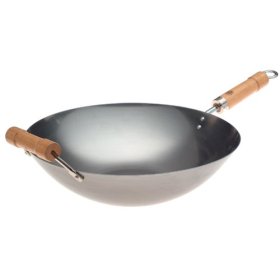
     Woks are a versatile round-bottomed cooking pan used in making Asian dishes.  They really aren't required for someone who doesn't make a lot of stir-fry.  If you come across one, go ahead, but you won't use it a lot.  Non-coated is best for these as you use oil that gets incredibly hot and can trigger the toxic fumes of non-stick.


Double Boilers:
     A double boiler is a heavy pot that boils water with a smaller pot that sets inside it.  The smaller pot is then heated by the boiling water which makes things cook slower and smoother.  I have found 3 applications for double boilers, and I don't even own one anymore.  Application 1:  Melting chocolate, Application 2:  Tempering eggs for custard, Application 3:  Cooking alfredo sauce.
     As specific as these are, double boilers aren't really necessary.  If you can get a stainless steel mixing bowls that will fit into one of your pans, you can make a double boiler of your own.  All you have to do is put about 3 inches of water into a pan, bring it to a boil then put your bowl above the water and use it for the purpose you need.   When I get to a recipe that uses this, we'll discuss it further.

What pan can you not live without? Questions? Comments?

Tuesday, June 26, 2012

Planning - Make a good shopping list

     Now that you've planned your meals for a week ahead of time, let's talk about how to make your shopping trip cost you as little as possible.  Believe it or not, I'm not talking about sale shopping, though that will be a topic in a future week.  What I'm talking about is sticking to your list.  Part of sticking to your list is making a list that takes care of everything you'll need for the period of time for which you are shopping.  The other part of sticking to your list is making sure you don't go places in your local store that don't have what you need.  Almost every time I've bought some weird little item it's been because I went somewhere in the store that I didn't need to go.
     Unfortunately, just having a shopping list will not stop you from impulse buys.  Only your willpower and conviction that you don't need anything extra will.  I have found that having someone with you while shopping will make you question your list faster than anything, so if at all possible, go alone.  That means, if you can go shopping while the kids are at school or at a friends house, do it.  I know that's not always possible, but it will reduce the whining and begging for things that will eat up your budget like Chef Boyardee and other convenience foods.  If you have to take the kids with you, well, you're going to learn how to say no.
    Let's make our shopping list again.  Make it like you did last week by going through your recipes and writing down what you need.  Now, check your regular necessities like eggs and milk not so regular necessities such as that sugar you ran out of last week.  Put everything together on one list along with quantities you'll need in one column.
      That looks exactly what we did last week, but now we're going to step it up.  To the right of each item write what section or aisle it is in your store.
      Don't know what's on each aisle of your grocery stores?  Two solutions:  First, go up to the customer service desk of each store you shop at and ask them if they have a store layout of which you can have a copy.  You'd be surprised about how many of them do.  If they don't, either take a notebook into the store and manually write down the sign above each aisle.  That means you'll have a page labeled with the grocery store (and cross streets, if like me, you have multiple stores of one type near you) and what's on each aisle in that store.  If you don't want to do it manually, take your phone with you and take pictures of each of the aisle signs then go home and organize them however you want.
     Now that you have everything sorted into where you can get it in your store.  Make a second shopping list that's categorized into the sections of your store.
     Notice that I have shrimp in two different places on this list.  That's because I want to look at the price of both of those sections before I decide which section I'll buy from.  Start at the front of your store and work around the side first.  Most grocery stores have their produce, meat, and dairy along the sides of the store.  Once you finish the side, you'll be at the back of the store, or farthest away from the cashier.  Look at the aisle to which you're the closest and see if it's an aisle on your list.  If it isn't, don't go down it!  Find the aisles on your sheet and get just the item or items from that aisle and leave it immediately.  Cross off the item when you get it so you don't forget anything.
     If something catches your eye while you're in an aisle, don't just pick it up.  Stop and think about what it is and why you need it.  It's completely possible that you just remembered you were supposed to put Ranch dressing on your list when you ran out of it on Tuesday.  That's fine.  But if it's something like Oatmeal Creme pies, you probably just want them.  Look at them and their price and decide if they're worth that little luxury item at the end of the month.  They usually aren't because they won't last as long (Oatmeal Creme pies are always lucky to make it home with me).  Leave it.


What do you impulse buy and why? Questions? Comments?

Monday, June 25, 2012

A War Against Convenience Foods Part 2 - Cheese

     This is probably going to be one of my shortest entries in my convenience foods section, so why don't I take a couple of paragraphs to explain why I'm waging a war on them.  Please note that most of these don't actually have anything to do with cheese.  I'll get to cheese in a bit.
     Convenience foods are three things:  1) they're convenient, 2) they're expensive, 3) they're unhealthy [mostly].  Now, one of those things may seem pretty good, mainly that you think you'll spend less time if you have a box to make your dinner.  I won't argue that box dinners have all the ingredients that you need, except for meat and water.  Heck some of them have the meat now.  But here's the problem, they also have a lot of added salt, chemicals, and soy that you really don't need in your diet.  I'll take a week about soy someday, but for now let's look at the thought process here.
     Any time you buy a box dinner you're buying things you can get off the shelf for a lesser price then mix them together to make the same dinner.  If you buy a chicken and dumplings box dinner, you'll get canned chicken (added salt), canned vegetables (added salt), dried chicken broth  (added salt and chemicals), and what amounts to Bisquick to make your dumplings.  The next time you're tempted to buy a box of this stuff, go find the ingredients to make what you want and weigh it out.  Sure a box of Bisquick might cost more than that box to make 1 dinner, but you can use said box for tons of breakfasts and dinners.  Next week, I'm going to completely deconstruct one of these dinners and tell you what's really there.

     Now on to the cheese.  Not all cheese - shredded cheese specifically.  Why?  Because when I looked at my cheese aisle the day after starting this blog I realized that shredded cheese is, in it's basic form, tricking you.  A bag of shredded cheese that looks the same size of the block of cheese next to it costs exactly the same.  That sounds like a deal until you realize that the bag weighs half as much as the block.  That means that the same amount of cheese is twice as much shredded as it is in a block.
     To make matters worse, the bags of shredded cheese are now kind enough to put announcements like "2 cups" on the bag on the opposite side of the weight.  If you were in scouts or ever listened to anyone who was, you've probably heard the old saying "a pint's a pound the whole world 'round."  When you realize that 2 cups are in a pint and 2 cups are 16 ounces you probably think that 2 cups of cheese is equal to a pound.  Here's the thing.  A pint is a fluid measurement while a pound is a weight measurement.  That means that, though a pint is 16 fluid ounces, that doesn't mean that it's 16 dry ounces.  In fact, the bags labeled "2 cups" also say that they're 8 ounces.
     Ok, so you might now realize that you're paying twice as much for the same amount of cheese, but now you're thinking "But it's already shredded!"  Remember the first part of what convenience foods really are was "convenient."  I can't argue that.  Be honest though, how much is that really worth?  Can't you get a cheese grater and grate a block of cheese?  Heck, can't you teach your kids to do it?  My daughter loves grating cheese.
     The other problem with grated cheese is that it goes bad a lot faster than a block of cheese.  Remember, bacteria and mold only show up on the surface of a product.  That means, if you have a block of a cheese, you have 6 sides that mold can grow on, and honestly, you can cut that mold off when you're ready to use it again.  If you have shredded cheese, every single piece of shred has 2 sides where mold can grow.  Once mold starts to grow, it'll go to another piece and another and another until you have mold everywhere in your bag of cheese and you have to throw away what was left.
     So, the next time you need cheese, buy a one or two pound block instead of an 8 ounce bag of shredded.  Then, get out your grater when it's time to use some shredded cheese; grate what you need, and put the rest back in the fridge in plastic wrap.  If you're a family that uses a lot of shredded cheese and you want a bag, consider a food processor with a shredding blade to get it done quickly.  Or, you can grate the whole block manually and think about how many calories you're burning.

What convenience foods do you use? Comments? Questions?

Sunday, June 24, 2012

Why Don't We Cook?

     Regardless of our socioeconomic status, most people, these days, don't cook a fresh dinner for their families.  One study shows that about 40% of us cook a meal on a regular basis rather than using a convenience food, ordering delivery, or getting fast food.  When, at last count, at least 20% of America was below the poverty line, I have to wonder, how many people below the poverty line are in the 40% that make a meal.  I've known a lot of people in a lot of different economical situations over the years.  People who have no economic problems and people who have struggled their whole lives.  I hate to say it this way, but in my experience, the fewer monetary problems people have, the more likely they are to make a dinner from scratch.
     I don't mean to say that the people I've met make up a perfect cross section of the population, but it may be true that the greater economic stress that someone is under, the less likely they are to cook.  It makes sense, when you think about it.  Also, those who are under economic stress tend to work during dinner hours which means the kids get a box of mac and cheese for the babysitter to make.  It's a valid point, if your baby sitter is only capable of making things with directions on them.  (Solution:  Make casseroles in disposable pans and freeze them with directions written on the lid.  Leave them out for the babysitter to put in the oven.  I'm assuming you leave your children with someone who can learn how to operate an oven.)
     Regardless of how normal my friends and acquaintances are, I've found that the reasons they give me for why they don't cook are either indicative of how I think America thinks or really crappy excuses.  Here are a few:

"It takes so long"
     This is my least favorite excuse of all time.  Usually the people that say this play Farm Town on Facebook for at least an hour a day.  To paraphrase my cousin's wife in a statement about exercise:  "Bullcrap, if you're on Facebook, you can cook."  It all depends on the type of recipe you use and how you cook it.  No, you can't cook a whole beef roast within 45 minutes of coming home.   Well, you can, but it'll be awful.  But you can cook a roast chicken in an hour and a half.  An hour and a half sounds like forever, but it's also a recipe that requires very little involvement from you.
     When I'm looking for recipes for my family I look for one of two things.  a)  I can finish it in an hour or less - preferably 45 minutes, or b) I can use the crock pot.  The beautiful thing about crock pots (which I'm going to talk about in equipment someday) is that you can throw something in them before you leave for work in the morning and come home to a completely cooked meal that night.  Honestly, a crock pot roast involves about 15 minutes of work for me.  You can't convince me that you can't take 15 minutes out of your day.

"I don't cook well."
     To this, I ask you, "How well did you drive the first time you got behind a wheel?"  Look at every skill you have and think about how hard it was when you started.  Sure there are things we're naturally good at, but even those need refining into excellence.  I tell my daughter that there isn't an Olympic gymnast in the world that was born able to do a triple back flip.  They had to try and fail many, many times before they could do it.
     If you "don't cook well," the best thing for you is to keep trying.  Here are a few tips to start you out:
  • Don't salt things in the pot until you learn exactly how much to put in.  Sure salt is a flavor enhancer, but if you put too much in, your dish will be completely inedible.  Instead, make an item and put a salt shaker on the table.
  • Learn what things really taste like.  The problem with a lot of us is that we're so used to over seasoned, fried, salty, and chemically enhanced foods that no one knows what food tastes like anymore.  That means, the first few dishes you make will probably taste bland because you're tasting food.
  • Get a few herbs.  My basic herbs follow Simon & Garfunkel.  I always have dried sage, rosemary, and thyme in my cabinets, no matter what.  Parsely's fine, but it won't do you huge amounts of good.  When you're seasoning for a dinner for four, either gently sprinkle one or all of these over the top, using the shake top.
 "I don't have what I need."
     Well, don't cook that recipe then!  It's simple.  Don't make a crock pot meal if you don't have a crock pot.  Unless you have absolutely nothing in your kitchen as far as equipment, this is not a viable excuse.  If you've just moved out on your own and literally have nothing, well, you get to say that.  However, follow the steps I've lined out in my first equipment posting to find some good things.  Use future posts to figure out what you really need.  To start with, find a skillet, a 4 qt sauce pan, a sharp knife, and a cutting board.
     If you're referring to food, go shopping!  If you've not managed the ability to have any food in the house yet, follow my planning techniques to figure out how to stock up and have an inventory of things with which to cook with.  If you want to make something and the ingredients you have aren't the ones you have, make something else!

"I'm tired of cooking."
     This is one I hear from older adults who have spent most of their life cooking, but I've heard it from young moms too.  My first reaction to this is "tough" because I know I don't have a choice.  We're all tired of doing something that we absolutely have to do.  I'm tired of doing laundry.  Does that mean I don't have to?  Nope!  I need clean underwear whether or not I want to wash them.  Unfortunately, food manufacturers have offered us slightly less expensive alternatives to cooking than cleaning companies to laundry.
     Here it is plain and simple:  You can cook or spend money on unhealthy alternatives.  Your choice!

"My kids are picky eaters."
     This is a close second to "it takes too long" for me.  This is how I was raised - dinner was served, I ate it.  If I didn't like it, I didn't have to eat it, but I didn't get anything else.  We had 3 people in my family and we ate 1 meal.  If friends came over, they ate exactly what we ate.  The same goes if my daughter's friends come over, with one exception.  Her best friend's family is vegetarian, so we do try to make a vegetarian dish whenever she's having dinner with us.  Even then, we all eat the vegetarian dish even though my family is made of people that like to eat things that have faces.
     Here's the thing:  Your kids will eat when they're hungry.  If you're already in a cycle where you have a different dish for each member of your family, this is going to be hard, but it's not impossible.  The next time you make dinner, think about the ingredients in it and try to figure out if there's anything which anyone could object to or is allergic to.  DO NOT GIVE ANYONE A CHOICE!!!! Make your dinner for the number of people in your family and serve it at a table.  If your kids don't want to eat it, let them go hungry, but don't let them get up from the table.  If my daughter refuses anything, we make her sit with the rest of the family until we're done eating.  She knows, however, that if she eats well and asks to be excused, she can get up at any time.
     Giving your kids a choice is the first pitfall in making a cheap and easy dinner.  If I gave my 9-year-old a choice, we'd eat macaroni and cheese every, single, flipping day and we'd eat ice cream after.  Instead, I give food; she eats it.  She eats it because she doesn't have a choice.  If your kids have a choice now, it's probably going to take a while to convince them that they don't any more.  You're in the perfect time to retrain them too because school's out (unless you're in a 12-month school district).  If you are sending them to a school, camp, or other place where someone might be concerned about your kids being hungry, speak candidly with their teacher/leader/whatever about what's going on.  Tell them exactly what you served for dinner and that your child had plenty of time to eat and chose not to.  If they have kids or work with them, they'll understand.
     Finally, if there are things your family hates, try to avoid them at first.  Make things you know they can't say, "You know I hate mushrooms" to for at least 2 weeks before you start sneaking them in (please don't sneak in allergens).  I personally hate mushrooms, but they don't really provide me with a nutritional benefit, so I just don't cook with them.  Carrots, however, are different.  Your kids need carrots, even if they hate them.  There are some amazing techniques that involve food processing carrots and broccoli and adding them to meatloaf where your kids can't see them.  I think I'll go over sneaking healthy foods into your kids' food soon.

Why don't you cook? How do you overcome that? Questions? Comments?

Saturday, June 23, 2012

Your weekly frugal recipe - Chicken Carbonara


Chicken Carbonara
The Food Stamp Way

SkillsPrepCook

Equipment you'll need
Chef knife, cutting board, deep skillet or sauté pan, 4 qt. saucepan or pot, colander, mixing bowl
Serves 4

IngredientAmountCost
Spaghetti1 lb$1.34
Eggs4$0.46*
Butter2 Tbsp$0.17*
Whipping Cream1/2 c.$0.52*
Bacon4 oz$0.90*
Onion1 medium$0.50
Chicken Breasts2$6.16
Grated Cheese1/2 c.$0.53*
Parsely1 bunch$0.44
Total
$11.02
* Based on price per package divided by amount used.
Price per plate = $2.76

Notes about ingredients:
Butter: Use margarine if that's what's common in your house
Whipping Cream: Half and half is lower in fat and is usually less expensive. When I went shopping, 16 oz of half and half was $1.00 while the same amount of heavy whipping cream was $2.08. 1/2 c. = 4 ounces
Chicken Breasts: Chicken thighs are less expensive. My store has chicken breasts for $3.08 per pound while chicken thighs were $2.26 per pound. Assume 1 pound per chicken breast or about 2 thighs each.
Cheese: Buy solid cheese and grate it yourself for savings
If you use these substitutes, the price for the dish is now $9.11 with a price per plate of $2.27!
Prep Instructions:
Cut the chicken breasts or thighs into uniform strips
Chop the bacon into very small pieces.
Chop the onion into small pieces.
Crack the eggs into a bowl and beat them thoroughly with a fork or whisk.


Instructions:
1.  Bring water to a boil in the sauce pan and cook the spaghetti in it for 10 minutes, or until soft.
2.  While spaghetti cooks, place bacon in sauté pan and cook thoroughly.  Drain off the grease.
3.  Add butter, chicken strips, and onion and cook until chicken is tender.
4.  Drain the cooked spaghetti and add it to the sauté pan.  Add the cream and salt and pepper to taste.  Stir over heat until it begins to boil.
5.  Add the cheese and eggs.
6.  Turn off the heat and stir well.
7.  Top with chopped parsley and serve immediately.

I must also note that I had everything in this recipe except for the half-and-half, so this recipe technically cost me about $0.25.  Herein lies the beauty of having stores of food, but we'll get to that later.  Also, it seems that the portions in this are really large, so you might have some for leftover night which further decreases the price per portion.
What recipe would you like done the food stamp way? Comments? Questions?

Friday, June 22, 2012

Luxuries - Wine

Let me preface this entry by standing on a soap box for a moment.  If you are on government assistance, please don’t drink alcohol.  Alcohol is expensive, and you need that money in your budget to pay for your bills.  I say this as someone with experience.  First off, I don’t drink beer, but I don’t drink wine or spirits unless it’s something someone has brought over.  In the years I have been on food stamps, I have bought alcohol for my consumption about once a year.
Here’s the thing.  As much as we’ve tried to disguise them as debit cards, most people know exactly what a food stamp card in their area looks like.  They also, whether we like it or not, notice what someone who is using a food stamp card is buying.  There is nothing that upsets many people more than seeing someone using a food stamp card and having a 24-pack of beer on the belt behind them.  Now, most people know you can’t use government benefits to buy alcohol, but they equate that to you taking clothes off your children’s backs to buy beer.  It’s unfair, but it’s true.
Now that I’ve said that, I have to admit that there are plenty of recipes that just aren’t the same with a quarter-cup of wine.   The important thank to remember about wine in cooking is that there is no longer any alcohol once it’s been cooked.  What remains is the flavor that the wine gives to the food.  That being said, there are plenty of ways to get around having to get a new bottle of wine every time you want to cook something.
The issue with bottles of wine is that they tend to sour into vinegar if you don’t use them in a timely manner.  Now, the typical bottle of wine is 750 mL.  For those of you who aren’t up on your metric system, that’s a little over 3 cups, or 25 oz.  Most recipes you’ll find ask for between ¼ and ½ of a cup of wine.  That leaves about 85% of the bottle left over to either drink or go bad.  Either way, it’s a waste of money that you may not have, so here are some solutions:
Personal-sized bottles:
Many vineyards are beginning to put out four-packs of individual-sized bottles of wine.  These are about 187 mL (3/4 cup) per bottle, and sometimes you can mix and match them to meet your needs.  That means for between $5 and $7 you can have four resealable wine bottles that can you don’t need to open until you have a recipe for them.  If you find a place that allows you to choose your wines, you can get two whites and two reds and not need to spend the money on two packages.
Resealable packages:
 As many vineyards as are producing individual-sized bottles have now created resealable wine.  These are often small bottles as mentioned above or in paper cartons that resemble large juice boxes. These have threaded tops like a water bottle that can be tightened down at any time.  The thing to mention is that any wine bottle that has a threaded top is technically resealable, but the larger the bottle, the sooner your wine will most likely go bad.  See, wine goes bad because it mixes with the air which screws up the chemistry of the wine.  To get a wine you intend to reseal, get a smaller carton or bottle and it will most likely last longer than a typical wine bottle.
Box wine:
Wine enthusiasts everywhere wince when they hear those two words together.  Box wine has become the cliché for tacky over the years, but it doesn’t have to be – especially when you’re just cooking with it.  Here’s the deal with box wine.  It isn’t just a box full of wine.  It’s a bag full of wine surrounded by a box with a spigot on the front.  The thing about the bag inside is that it doesn’t have air in it, so as you dispense wine from the bag, it just deflates a little more.  The vacuum-packed bag makes it so you can keep a box of wine for months without it going bad.  Also, in my experience, a box with 2 to 3 liters of wine costs about the same as a cheap 750 mL bottle of wine.  The only problem with this is you still run the risk of waste, and you might not want to buy more than one box of wine, seeing as some recipes call for white wine and some call for red.  If you want to buy just one type in a box, opt for a white zinfandel.  It’s a blush wine, so it can go in both types of dishes.  If you run across a recipe that absolutely needs a dark red (white is usually pretty well taken care of with blushes), go find a resealable or personal with that type.

Like many things in this blog, this is intended to help you personalize your kitchen.  Only you know how much you cook with wine, so only you know how much you need in your kitchen.  If you’re a regular wine cooker, get a box.  If you only use it once or twice a month, get a set of personal sized wine bottles.  It’s your kitchen, you decide.

One more thing:  If you are on government assistance and you're going to buy wine, do everyone a little favor and buy it separately.  I'm not saying make a separate trip, but just separate the purchases.  For example, maybe you go in and buy your box of wine, then take it back out to the car before you come back in and buy your food.  This just helps us combat the food stamp stereotype.  If you don't know what that is, count yourself lucky.


What luxury foods do you want to talk about? Comments? Questions?

Thursday, June 21, 2012

Techniques - Deglazing

     Since I talked about deglazing in my first convenience foods post, I might as well go over it in my first techniques post.  See, I have a theory about the reason that a lot of people consider fairly simple recipes "fancy," "gourmet," or "difficult."  It's that they don't have the tools or techniques to perform the task.  If you make sure that you have a tool to do the job and you break down these difficult-sounding techniques, they're actually quite easy.
     Technically speaking, "deglazing is a cooking technique for removing and dissolving caramelized food residue from a pan to make a pan sauce."  (Source)  This sounds pretty awful when you read or hear it the first time, until you realize a few things:
1)  Deglazing uses liquid to take the stuck-on parts of what you just cooked out of the pan
2)  Deglazing captures the extra oils and flavors that are usually lost in the pan
3)  Deglazing makes a great sauce
4)  You've probably deglazed before

     Here's how it works.  You cook something in a regular, not non-stick pan and there are bits that are bound to stick to the bottom of the pan.  These are caramelized parts of what you've cooked.  This is especially present when you've cooked meat in the pan and have left it on one side or another for more than a few seconds.  Because we season the outside of meat, the caramelized pieces now contain all the seasoning that was on the surface.  That means you lose the seasoning!
     Easy fix.  Usually the recipe you're using tells you to deglaze the pan and with what liquid.  For example, Saltimbocca (recipe to come) requires you to deglaze with vermouth, while the beef broth recipe I gave you asks to use water.  Some ask for wines, and others ask for milk.  Usually, you're not going to be flying blind here.  However, if you ever are, use 1/4 c. of white or blush wine.
    Now, with deglazing, you'll need to work quickly as you usually add so little liquid that it will begin to boil immediately.  Use a rubber spatula and rub it along the bottom of the pan loosening each of the pieces that have become stuck to the bottom individually or as a group, depending how well they're stuck.  Do this until everything's off then follow the rest of the recipe as to what to do with it.  If the deglazing isn't in the recipe, you can either add the liquid directly to the dish or thicken it with a cornstarch slurry which, sorry, we haven't gotten to yet.  Unfortunately, we can't cover everything at once, but I'll put a link to it once I get it up.
    Deglazing works best when you have a pan that isn't non-stick pan, but you can do it if all you have is a non-stick skillet.  You won't get as much of the caramelized parts on Teflon, but you will get some of the oils and spices.  It works the same way, no matter what type of pan you have.

What do you want to learn to do? Comments? Questions?

Wednesday, June 20, 2012

Equipment - Pots and Pans 1

     There are two basic categories of equipment you absolutely need in your kitchen to make cooking gourmet meals:  Good knives and good pans.  We'll talk about good knives soon.  Today, I'll talk about good pans.
     Pans are one of those things that the old adage "You get what you pay for" has never been more true.  You buy a cheap pan; you'll get cheap results.  I have seen the pans in the dollar stores, and I cringe, assuming that they'd be good for precisely one use, if they got through that.  Perhaps you've had good results with them before, but especially if you want you simmer something on the stove for more than 20 minutes, you might want to look into a new set.
     Don't get me wrong, I completely understand that a good set of pots and pans is usually expensive.  Heck, almost all kitchen equipment is.  That's why I'm dedicating an entire post once a week to ways of getting key pieces of equipment for less than retail.  Very few people look forward to spending $200-$300 on a set of new pans, even if those will last them for the next ten years.  That's right, a good pan can last you upwards of a decade - even though people who cook a lot might replace them more often.  If you've ever noticed that your grandma has the same set of pans that she got for her wedding anniversary in 1978 and they work great - well, that sums it up perfectly.  Find yourself a good set of pans and you won't have to get another one for a long time or, maybe, ever.
     So, how do you get $200-$300 worth of pans on your budget?  There are several techniques for this that I'm going to go over then next week, I'm going to detail exactly which pans you really, really need in your kitchen and which ones require you to assess your needs before you run out and get them.  Most of these rules apply for all of your kitchen equipment, but I'm going to specify what you're looking for on your old pans and how to get new ones.  Over the weeks, I'll do this for different types of equipment.  I hope it helps.
1.  Don't get it all at once
     This is my favorite technique; one that my father and I have used for years.  Just because you know you need new pans doesn't mean you need them all at once.  Go to your kitchen and assess your pots and pans.  For the sake of ease, this week, we're focusing just on the ones you put on top of the stove - not the ones you put in the oven.
     For non-stick or Teflon pans, rub a spatula across the surface, not too gently, and not too rough.  If any of the Teflon comes off, put it in the replace pile.


Important!
Make sure it's the non-stick coating, not a burnt piece of something you left in there. If there's silver showing, it's the non-stick.

     If it's simply thin on the bottom, but not peeling off, put it in the "it can wait" pile.  Teflon is a toxic substance, and though it's usually only activated by temperatures over 300º F, but I don't like to take chances. Also, once non-stick coating starts to peel, it doesn't stop, and then things start to stick to your pan which makes you scrub at it which makes more non-stick coating come off...well, you get the point.
     For regular pans, look at them closely.  Rust doesn't necessarily mean that your pan is bad, it just means you have to be careful with it.  If you have things with dents, that means they're more likely to break or rust.  I'd put them in the replace pile.  Each of the other pans is up to you.  Rusty pans need to have their rust scrubbed out and dried thoroughly.  If you want to prioritize them for replacement go ahead, but focus on what you absolutely need to replace first.
     When you look at your replace pile, set each pan out in a line that organizes how much you use it.  For my family, that would have the skillet before everything else, but it's your kitchen, and you know what you need.  Also, see if you have any pans in that line that have capacities replicated in the "it can wait" pile.  Those can just go out the door and you don't have to spend that money yet.  Now you're hopefully left with one or two pans that you absolutely need to replace right away and a counter-full of pans you want to replace but don't need to yet.
2.  Buy used
     If you haven't discovered the wonders of Craigslist yet, Go!  Now!  If you live anywhere near a large city, there's someone bound to be selling off their pots and pans because they just got the brand new shimmering Emeril Lagasse set at Sears.  Or maybe they just moved in with their significant other and they have two of anything.  Who cares?  They're selling theirs at ridiculously low prices!
     On Phoenix's Craigslist, right now, I can find no less than 10 entries of people selling off old cookware that they don't want for one reason or another.  Some of them even tell you why.  For example, one woman says "Bought and used 1 pot and decided that I don't like using non stick."  She's selling a $100 set that she used one pot out of for $70.  A quick look at the set tells me it wouldn't last me a full 5 years, but that's 5 years you could use to save up for an amazing set.  Then you can sell the remaining pieces on Craigslist for a little extra cash.  If you use this method, you have to learn how to properly search for these items.  Try "pots" (the /s/ is really important here), "pans" (not so important), or cookware.  After a while you'll be able to figure out how people are posting in your area.
     Craigslist isn't the only place to search for used cookware.  You can go to the old method of garage saling (yeah, I just made up the spelling of that word).  Look for garage/yard/estate sales and peruse them for their pots and pans.  You'd be surprised at the prices you can find there.  My dad once found a crab pot for $5!
     Remember, two really important things when buying used.  First, used prices aren't usually set in stone.  In my experience, you can usually get a Craigslist seller down at least 5-10% from their asking price.  For the $70 set up there, ask if they'd take $60 and they'll probably counter with $65.  If you're going to try to do this, wait until you've looked at their items in person.  Asking for a reduction almost always goes over better if you're in front of them.
     Second, remember that items, whether they say they're used or not, are going to be used.  Look at each piece you're considering buying and assess its condition.  If it's not good, walk away.
3.   Ask around
     Remember when I mentioned your grandma's 1978 pots and pans?  There's a pretty good chance that your aunt gave her a new set of pans in the 1990s that she's never once used.  Despite what manufacturers may have you think, there haven't been a lot of technological advances in cookware in the past couple of decades.  Sure we've made thicker bottoms and handles that don't melt or even get hot, but when it comes down to it, a good pan is a good pan.  The next time you're over at a cooking enthusiast's house, offer to put the dishes away after dinner and look to see if there are any extra pans.  Then ask if you can borrow a few.  Your friends and family know you're on a budget, and if you mention that you're saving up money for a new non-stick skillet that will have a lifetime warranty but could really use a new one in the meantime, I'm sure they'll say they have an extra.  They might give them to you, or you might have to return them when you get your own, but either way, your soup won't be coming out a hole in the bottom of your stock pot.
     If you go this way and manage someday to have your own collection of pans you should've gotten rid of years ago, remember to pay the favor forward.
4.  Save your pennies
     This one's the toughest, but there are some real positive sides to it.  Currently, my father owns an Emeril Lagasse non-stick 14" skillet that retails for about $60.  That's a lot for a skillet!  However, this skillet is heavy (a really good quality in most cooking pans), has a non-heating handle, and a glass cover.  Moreover, it has a lifetime guarantee.  That means, if the non-stick comes off, my dad can call the company and have the pan replaced.  The same goes for the handle falling off, the lid cracking from heat (not from dropping it, they get upset about that), or the steel pitting and oxidizing.
     My dad bought this skillet after 2 years of having to replace $40 pans each year for different reasons.  That means he spent $80 on skillets before getting a $60 one that will most likely last him until he gets tired of it.  That's what I'm talking about when I say you get what you pay for!  Replacing a pan every year is a waste of the money you put into it, unless you have absolutely no option.  Getting a good set is guaranteed to save you money in the long run.

How do you save money on your kitchen necessities? Comments? Questions?

Tuesday, June 19, 2012

Planning - An introduction to meal planning

     When it comes down to it, the only way to guarantee that you can keep your food on budget is to plan and plan and plan and plan.  In my experience, the best way to go over budget is to buy food day-to-day without any forethought.  It might seem more convenient, but you'll end up either having to buy more than you need or buy multiple portions of something that would've been cheaper at a larger quantity.  Your first step should be planning your meals for at least the next week.  Go get a notebook that you can write everything down in and use my day off, Sunday, to plan out a week.
     On a scrap piece of paper, make a quick table:
SundayMondayTuesdayWednesdayThursdayFridaySaturday


       In those spots, write the protein you'd like to use that day. Depending on your family's nutritional restrictions, you can make this pretty easily. My family has no dietary restrictions, so I like to vary our protein. That means my table looks something like this:
SundayMondayTuesdayWednesdayThursdayFridaySaturday
 Chicken Pork Beef Fish ChickenBeef  Leftovers
      See the variation?  Pretty simple.  You make it work for you and your family.  You don't always need a leftover night; you may not get good fish where you are, or you might keep kosher and not eat pork.  Whatever works for you is what works for you.
     Now that you have a good idea of what type of meat you're going to eat, it's time to find your recipes.  My first step in this is to look in my cabinets, pantry, and freezer to see what I already have on hand.  That makes a big difference on what I'm going to make.  Remember, it's always cheaper when you don't have to buy anything!
     The ingredient search on Allrecipes.com makes this step go a lot faster.  If you know what non-protein items you have, you can plug a few into the "ingredients to include section" and put anything you know your family won't eat in the "ingredients to exclude" section.  Press search and see what comes up.  If nothing, remove ingredients until something does.  Find recipes that will fit your needs and write down the ingredients and directions in your notebook.  (Or print them and paste them in.)  Later, when you make the recipe, you can make notes as to how you liked the taste, what you'd change next time and how difficult it was.  Eventually, you'll have your own personal set of recipes that you can go to at the beginning of a week.  These are all recipes you know you've made before and if your family liked them or not.
     One of my favorite ways to find recipes is the Allrecipes dinner spinner.  This is a free app available for android (and I assume iPhone) that lets you completely randomize what shows up for dinner or select things you know you absolutely want.  For example, when I'm looking for dinner, I select "Main Dish" from  the category section and "45 min or less" in the time section.  Then I let the app randomize my main ingredient.  If I don't like what comes up, I go back and spin again.


Scan here to download Dinner Spinner for android

     Once you have your 6 or 7 recipes for the week, get out your shopping list.  Go through each recipe and write down each ingredient you don't have in the house.  Write down the quantities next to them.  When you find a duplicate item, mark out the previous quantity and put down a new one.  Here's how a typical shopping list for just me looks:
     Now you have everything you need to get through the week written down.  You know how often you'll use each of those ingredients, so if you have one that you use a lot, assess if a larger amount would save you more in the long run.  Next week, I'll talk about how to organize your list so that you can get your shopping done quickly and with little excess spending.


What do you do to plan your budget? Comments? Questions?

Monday, June 18, 2012

A War Against Convenience Foods - Beef Broth


     Today, I’m making beef broth.  Why?  Because we’re out and I think I can make it a lot cheaper and healthfully than I can buy it.  At my local Fry’s, I can buy Kroger brand beef broth for $1 per 14 oz can.  This seems great until you realize that canned goods have a lot of sodium in them.  Unlike many people, I’m not a huge fan of salt.  I prefer to cook virtually without it and to let people add salt as to their taste.  99 times out of 100, I won’t add salt to something that's already been cooked.
     So, my goal today is to see how much I can save making my own beef broth.  I’ll admit right now that my prices won’t be yours, but I think that, across the board, you’ll see that prices will be within the same ratio.  Next time you’re at your store, you can start your own book of prices and see what your conclusions are.
     Despite what you might think, broths and stocks are not hard.  They just require time to cook.  A good broth or stock will take at least 4 hours of simmering to get a good taste to it, then you just have to store it (I’ll get to that in a second).  Ergo, the next time you realize you’re out of chicken broth, take a day that you’re off work and let your own simmer on the stove.
     Big question I hear a lot:  What’s the difference between a broth and a stock?  Easy!  A broth is made with meat and bones while a stock is made just of bones.  I highly recommend that you make chicken broth rather than stock because chicken bones are so small.  On the other hand, beef bones lend themselves perfectly to stock.  You can buy beef marrow bones in your grocery store’s meat section for pretty cheap.
     Now, when you make a batch of stock, you’re going to end up with at least a gallon of the stuff.  That’s just how it works.  Unlike cans, you can’t stack it in your cabinets for an infinite amount of time, but you can freeze it.  You don’t want to freeze it all in one giant piece because you’ll never be able to get it out of the container once it’s frozen.  Here are a couple of options:
1.  Freeze it in a small container
     Find small freezer containers that hold 1 to 2 cups and put your stock in those.  They’ll stack nicely and you can defrost each container as your needs dictate.  Similarly, you can freeze them in quart-sized Ziploc bags, but you have to make sure you a) seal them very well and b) lay them flat on a pan to freeze.  Once they’re frozen they won’t leak and they’ll stack nicely in your freezer.  Just label the bags with what they are and pull them out when it’s time to make soup.  Defrost both of these in warm water until you can get them out of their containers, then just add them, frozen, to your pan.  Everything’s hot when it boils.
2.  Make ice cubes.
     I love this method because it’s less wasteful than a lot of Ziploc bags and small containers.  Buy a few ice cube trays at the dollar store, and after your stock is cool, carefully ladle the stock or broth into the trays.  Let them freeze, pop out the cubes into a larger container or gallon Ziploc bag and stick them back into the freezer.  Remember that liquid expands when it freezes, so leave some extra room.  Repeat this until all of your stock is frozen into ice cubes.  The only problem you might have is when you’re ready to use them.  Every ice cube tray is different, so I can’t tell you how big yours will be.  Here’s a tip:  When your first set of ice cubes is done, remove one of them and put it in a measuring cup and let it melt.  When it’s melted, you’ll know approximately how much is in each ice cube.  On your container/Ziploc bag, write “Beef Stock, 1 cube = 1 oz” or something you’ll understand.  That way, when you’re ready to make a soup that requires 1 cup of stock you’ll just pop 8 ice cubes into the pot and be ready to go!
     Here’s my beef stock recipe and how much each piece of it cost.  For things I already had in my kitchen, I’ll approximate the cost.  At the end, I’ll tell you how many cans of beef broth I could’ve bought for the cost and how much I made.  You choose what you prefer.
Equipment you'll need
Chef knife, cutting board, small roasting pan, oven, stock pot (1 gal or larger), stove, colander, slotted spoon, containers/ Ziploc bags/ ice cube trays.

IngredientAmountCost
Beef Marrow Bones1 package$6.64
Large onion1$0.50
Large Carrots3$0.30*
Celery Stalks2-3$0.43*
Kosher Salt3 tsp$0.07*
Pepper1 tsp$0.10*
Bay Leaf1$0.15*
Tap Watera lot
Total
$8.82
* Based on price per package divided by amount used.

1.  Preheat your oven to 450º F.  Cut your onion and carrots to large pieces, about 1 inch in size.  You need to peel the onion and you need to wash the carrots, but you don't need to peel the carrots.  The peel is just more of the carrot and will add more taste to the stock.
2.  Put the carrots, onions, and beef bones into a roasting pan (I used a 6x11x2) and put them in the oven for 30 minutes.
3.  Drain the fat from the roasting pan.  You may need to use a slotted spoon to lift the vegetables and bones from the pan in order to get the fat out without dumping your ingredients.  After the oil's gone, add 1/2 c. of water to the pan and scrape anything that might have stuck to the pan off of it.  Pour the water into the stock pot - this is called deglazing.
4.  Place the bones, carrots, onions, celery stalks (cut similarly to the carrots and onions), salt, pepper, and bay leaves into the stock pot.  Fill the pot with water.
5.  Place your stock pot on the stove and bring it to a boil.  Cover the pot with a lid and reduce the stock to a simmer for 4 hours.
6.  Once the stock has completed simmering, allow it to cool completely, until the fat on the top has solidified (this took overnight in a fridge for me).  Use a slotted spoon to remove the fat and discard it.  Strain your stock through a colander and freeze.

This recipe cost $8.82 which would buy 8 - 14 oz cans of generic brand Beef Stock if I include sales tax, however, I had everything but the bones in my kitchen which means it was only $6.64 for me.  This is also something great to do with that wilting celery and blackening onion you've got in your kitchen!  So, if I look, purely at my cost, I could have bought 6 cans of Beef stock
My recipe made 2 gallons of beef stock.  That's 256 ounces or 18.29 - 14 oz cans of beef stock.  For $6.64, I got $18 worth of stock.  Frankly, that's enough to get most families through the year!

What convenience foods do you hate? Questions? Comments?