Showing posts with label planning. Show all posts

Tuesday, July 24, 2012

Planning - Frozen vs. Fresh vs. Canned part 1

     Possibly one of the greatest misconceptions about cooking great food is that you must use things that are in the produce or butcher section of your grocery store.  In short, it's believed that you can't use anything canned or frozen to make a good meal.  I beg to differ.  In many cases, frozen and canned foods are not only as good as fresh food, but are able to be kept indefinitely in your cabinet or freezer (choose wisely, haha).     Now, I won't argue that fresh fruits, vegetables, and meats are the best, but I'm not sure where this belief that things can't be frozen and remain good.  For goodness sake, I freeze the meat I buy to make it last longer, why can't manufacturers do the same?  It's also worth mentioning that even some of the fresh foods you find in the grocery store might be of worse quality than what you find in the freezer section, so here I'm going to go over fresh, canned, and frozen fruits, vegetables, and meats so that you can determine what's best for your situation.

     I was going to try to write this all in one week, but after I got started, it was so long, I just couldn't bear to subject you to the whole thing (you're welcome).  So, this week, I'm doing fresh food.  Next week, I'll either do canned or both canned and frozen.

Fresh:
     The big issue with a lot of fresh foods is that they must be bought in season in order to keep them to our budget.  That means you can only have certain items at a certain time of year before they start having to be shipped from Chile to get them.  Nothing against Chile, but strawberries that are shipped from there are going to cost more than the ones that came from the farm up the road.  I experienced my first organic food market when I lived in California, and it only sold fruits, vegetables, and meat from farms within 100 miles.  For the longest time, I didn't understand what people were talking about when they said organic food cost more because those prices were the lowest in the town.  You know why? because they didn't have to pay nearly as much in gas and transportation costs as did the grocery stores that were getting off season items from Mexico.  If off-season items are on sale, the chance is pretty high that they're selling unripe food and expecting you to ripen it on your own.
     The other problem with buying fresh produce and meat is that you can't store it like you can frozen and canned food.  Like most of the things on this blog, fresh produce has no preservatives and will go bad within a week or less, depending on its ripeness.  Now, with the meats, as I've already lined out, you can buy in bulk and freeze, but it's very rare that you can do the same with anything that didn't come out of the butcher's section.  Trust me here, you can try to freeze your own fruits and vegetables, but it won't go well.  That being said, if you want to write an article on home canning, email me and we'll talk.
Meat & Poultry:
     Meat is one of those things that doesn't ever seem to go out of season.  With the amount of meat storage that many manufacturers have now, we have access to all types of meat throughout the year.  That being said, beef, pork, and chicken are pretty much immune to season prices.  That means that the beef, pork, and chicken industries have good enough storage and high enough production rate that they never have to worry that they're going to run out.
     When you're shopping for red meat, it may surprise you that it doesn't actually need to be red to be good.  Most producers of meat use sodium nitrate to "fix" the color in the meat.  That means that it actually dyes the meat red.  The brighter the red on your meat, the more preservatives are in it.  I like to try to find brown or pink meat because I don't like the idea of artificial colors.  However, that's not usually fiscally responsible.
     The basic rule of meat and poultry is that, if it's not green, it's fine to buy.  My favorite section of the meat department is the "day old" section where they put the meat that's going to expire within the next two days.  That stuff is about half the price of everything else, and as long as you either use it immediately or freeze it, it's fine for consumption.
Fish & Seafood:
     Conversely, meat that comes out of the water has definite seasons.  There are times you just can't find certain fishes and seafood in the fresh section of your grocery store, and even more times you can find it for an incredibly high price.  It doesn't matter if its fresh or saltwater fish, there are certainly times that they're less expensive than the others.  Most people don't spend the money on fish, but as I'm going to line out someday in Luxuries, they're really essential to your kids' brain development.
     Some of the fish and seafood you'll see will say that it's never been frozen - not that important to me - but the thing I rely on most is the smell. You know that old saying "it smells fishy"?  Well, fish should never "smell fishy" because that fishy smell is the release of ammonia from the dying carcass of the fish.  Seriously, if your grocer's fish counter ever smells like that, walk away, quickly.
     As far as shellfish goes, here's a quick and easy calendar you can click on and print to know when different seafoods are in season here in the U.S. and Canada.  If you live in the UK, you can go to this site to make your own.  All other countries, tweet me and tell me what your websites are and I'll add them too.
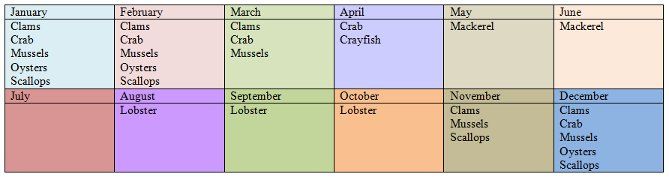
No, I'm not expecting you to go buy lobster, like ever, but it was included in the different types of seafood.
Vegetables:
     Vegetables are tricky.  There are some that never seem to go out of season and there are others that you can never find on sale.  Some of them will never be in your grocer's frozen or canned sections (lettuce), some of them, you can't find anywhere else (palm hearts).  Vegetables are far more hardy than fruits, so they'll stay good longer.  When you're looking at vegetables that are on sale, ask the store's produce guy how to tell if an item is ripe or not before you buy it.  Well, you can do that or use a smart phone to search the internet.  The produce guys in my grocery stores always know, and sometimes the store puts a guide to buying ripe vegetables on the signs.
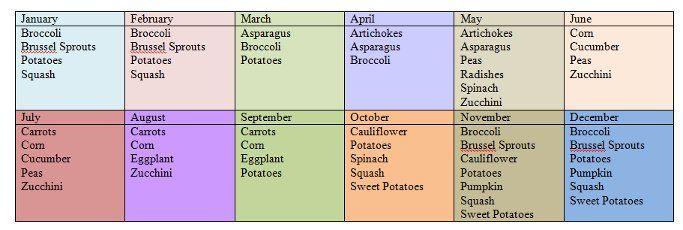
 Now, that's not anywhere near all the vegetables that you could possibly find.  If you want a full, comprehensive list for the US, look here.
Fruits:
     Fruits are delicate, to say the least.   When you buy a ripe peach, you're lucky to get through 2 whole days before it starts to rot.  If you buy an unripe fruit and ripen it yourself, you won't get the same taste as a tree or vine ripened of the same variety.  Further, some vegetables will never taste right, if your store or you don't treat them right.  A perfect example of that is the tomato.  Did you know refrigeration stops the ripening process of tomatoes?  That means that, if your grocery store transports its fruits and vegetables in a refrigerated truck, you will never get a ripe tomato from the produce section.  Depending on where you live, those types of fruits might be best bought canned or frozen.
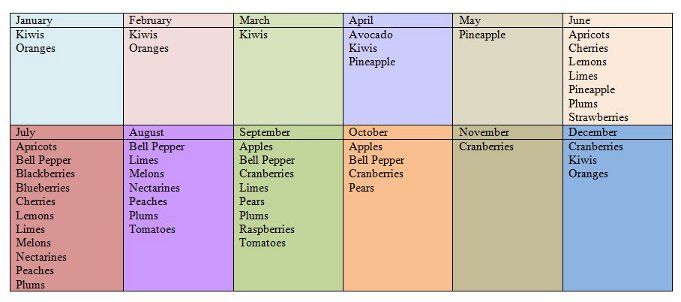
I don't know how your brain works, whether you prefer to have these in categories, or all at once, but while I made the lists, I kept a comprehensive list going in alphabetical order.  You can just print this one:
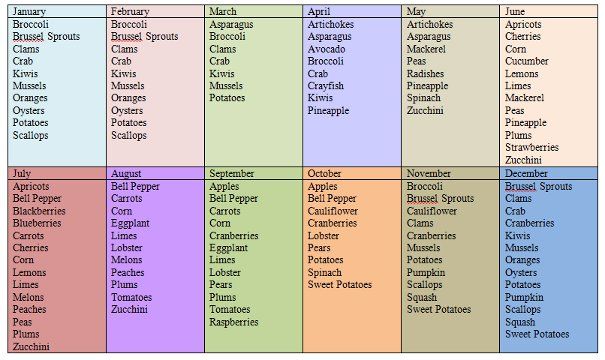
All of that information was obtained through this site, but I thought it'd be easier for you to see it put together like that.  You can always visit here to see what's in season this week.
     If you'd like to get some inexpensive vegetables that are in season where you are, you should check out sites like bountifulbaskets.org that provide low-cost fresh vegetables from local farmers.   We've done that a few times and have always had a great time trying to figure out what dishes we were going to make from 2 heads of cauliflower and an eggplant.

Tuesday, July 17, 2012

Planning - Sale Shopping


     Every week, on Tuesday, my mailbox is filled with something that looks like this:
That would be the full ton of ads that appear at our house on a weekly basis.  In there are ads for pool supply companies, furniture stores, and other stores in the area.  If you dig through them and know what the names of your grocery stores, you can find the weekly specials on food in your area.  The problem with sale shopping is that we usually end up spending more than we would have without the sales.  That's what this post is dedicated to - making sure you actually save money when you shop using the ads.
     The problem I usually run into is that the ads always make me say, "Hey! We haven't had that in a while!" and I go get it.  Though this seems innocent on the surface, the issue is that, if we haven't had it in a while (like six months), the reason was probably because we didn't need it.  Why do I want to go out and buy something that we don't need just because it's on sale?
     Unfortunately, that's what the grocery stores are hoping to get you to do.  They want you to go buy things you don't need or won't use because they were on sale.  I will say that sales provide you a great opportunity to try new things, but only if they fit in your budget.  They also provide you the ability to stock up on things you will use when they're on sale.  The problem is finding the balance.  So, this week, when you get the grocery ads, look through them and ask yourself these questions when you see something that draws your eye:
  1. Do I need that?
  2. Do I have it?
  3. How much will I save?
  4. How much will I spend to get it?
     See, we tend to buy things we already have or that we don't need.  For example, just because fruit roll-ups are on sale doesn't mean I need them.  On the other hand, if I have 5 cans of carrots and the ad says they're 50¢ each if I buy 10, do I need that many?  How much will I really save if I go get that $5 of canned foods?  How far do I have to travel?
     Let's look at each item in your grocery ads and figure it out.  Some of my grocery ads say what the price usually is, but most of them say things like the circled part:
 On the surface, that looks like a great deal.  You could save up to $2!  But wait, you have to buy 10 avocados to save that $2 which means you only save 20¢ on each one.  I'm not saying it's not a good price on avocados, I'm saying you probably won't save what you think you will.  Were you planning on making guacamole this week?  Do you think you'd use more than 2 avocados for it?  I know my family wouldn't, even if we were making it for the extended family.  At the most we'd use 3 which is still a savings of 60¢, but it isn't the $2 the ad promises.  The fact of it is, that you're usually not going to buy the quantities that the grocery ads advertise.  I can't remember the last time I needed 10 boxes or cans of anything.
     The nice thing is, a lot of grocery stores have started getting away from you actually having to buy the ten items to get the sale price.  The stores I shop at usually allow you to get a 10 for $10 item for $1 a piece instead of requiring you to buy 10 of them.  This is really beneficial.  However, you should know your local grocery stores, so you don't end up with 7 rotting avocados because they don't separate the price.
     There is one exception to this rule.  One of my grocery stores has a special they run about once every 2 months that states "Save $5 when you buy 10!"  The idea is that you buy 10 of the items they specify and you save 50¢ on each item.  When they run these ads, they often have over 30 items to choose from.  The problem is that I often need two or three of those 30 and I have to decide if I want to buy 5 of each to save my 50¢.
     Sale shopping is tricky that way.  The money you spend this month is probably money you don't have to spend next month.  For example, if your local store has a buy one get one free sale on ketchup and you're not out of ketchup yet, do you buy it so you don't have to get it in a month when you are out?  Each sale is different, so you have to evaluate everything in your ads and decide if you're going to use it.
     Step 1 is to decide if you need what's on sale.  If you're me, you're going to automatically decide you don't need anything that's premade or premixed.  With few exceptions, eliminate your convenience foods and junk foods.  Also eliminate anything you don't normally use or fresh foods you won't use this week.  For example, if fresh broccoli is on sale and you're not planning on using it within the week, it's a waste of money to buy it.  Frozen broccoli isn't so much.
     Step 2 is to see if you have what's on sale.  Like my example with ketchup a moment ago, you have to go look and see if you have what you're looking at before you put it on your list.  If your ketchup bottle is 3/4 full, don't go get two more unless you use a full bottle in a month.  If, however, it's sitting upside down with 1/2 an inch of ketchup in it, go ahead and get your two bottles for the price of one and you won't have to worry about it for a while.  The most common exception to this rule for me is canned food.  If  I have less than 10 cans of a vegetable, I'll probably replenish my stock when they go on sale, even if I only buy two cans each.
     Step 3 is to see how much you're going to save.  After you do this for a while, you'll know what a good price is for an item you buy often.  If I say to my dad, "What's a good price on chicken breasts?"  He'll automatically respond with "$1.39 or less."  If you're just starting out, look at the original price in the ad or how much it says you're saving.
     Step 4 is probably the one no one thinks about when they're making their list.  How much are you going to spend to get the sale price?  If every ad you have in your mailbox comes from a grocery store that's within 5 miles of you, you really don't have to worry about this.  However, I have grocery ads from stores that are in excess of 10 miles away from me.  I have to decide if the sale prices in those are worth the gas I'm going to spend to get there.  The answer is usually no, but I hate to pay full price if I know it's on sale elsewhere.
     I've found a solution to this problem, at least where I live.  See, I have a grocery store that most towns have that promises to match the prices from local grocery stores.  I'll put money that you've got one of these stores nearby.  I'll give you a hint, their stores are usually painted blue and grey and start with the letter W.
     The beauty of price matching stores is that I don't have to drive all over town to get the lowest prices.  The problem is you have to know exactly what you're getting and for what price.  You should probably also go on a day and time that isn't so busy because there's nothing worse standing behind someone who's saying "Those bananas are 88¢ a dozen at Safeway" for ever item in their cart.  So, here's how to plan your shopping list, whether you're price matching or not:

Not price matching:
     Take your ads one at a time and pour over them like I've mentioned above and have a piece of paper nearby to write them down.  Write the store's name at the top and then make your sale list under it.  Organize your stores from farthest to nearest and go to them one at a time to get your sale items.  Any items that aren't on sale should be purchased at the last store you go to so that perishables aren't sitting in your car.  For that matter, this method is especially dangerous if you're buying perishables in multiple stores.  I'll admit to taking vegetables and meat into a store that I need to get other items in.  Make sure to take your receipt and keep your groceries in their original bags to prevent the greeter from questioning your honesty.

Price matching:
     This is the best thing to do if you have perishable goods on sale at 4 different stores.  Really.  You avoid having to go to the stores and take your food into each one or go home between each one.  To do this, go through your ads like I mentioned before, but this time, write down the price of each item next to it and the store at which it's on sale.  When you do this, you have to write down any brand names that might pertain to the item.  For example, if Farmer John sausage links are on sale, you need to note the brand.  If there's a specific size that's on sale, write that down too.  This might seem like a lot of work, but it will save you a lot of time in the long run.
     When you go shopping, make sure you get what's on sale in the ads.  If the sale item is the store brand for that store (Kroger, Fresh Select, etc.) the stores that match prices will usually substitute their store brand for those.  The first time you do this, take your ads with you.  That way, if your checker asks for proof of the sale price,  you can show him or her.  Put your items on the belt with your non-price match items first.  That way, you're don't have to stop unloading your shopping basket to tell your checker what price is what.  Have them written down clearly so you can say each item and its sale price.  Make sure you can break down the price for the checker if you have to.  For example if your Farmer John sausage is on sale 4 for $5 at Fry's, be sure you can tell the checker that the price per unit is $1.25.  Sometimes, they need that help.
     When you do this the first time, be prepared to show the ads if you're asked.  In fact, be prepared to do the same for the first few times.  Eventually, you'll know whether the checkers at your price matching store are going to ask.  I've never been asked once for the ad.

Tuesday, July 10, 2012

Planning - Protein

     There's no denying that the most expensive part of your food budget will be your proteins.  It doesn't matter if your family is vegetarian, white meat only, kosher, halal, or has no dietary restrictions, protein is freakin expensive.  The problem is that none of us can survive without protein.  You have to have some form of it to make sure your muscles function properly and can heal from injuries.
     The issue with protein is that small amounts aren't usually on sale.  In fact, the larger the amount, the less it tends to be per pound.  You'll notice, if you look, that a pound of 80/20 hamburger might be $3.83 a pound, but 5 lbs might be $15 even and 10 lbs are $25.  That's a good amount of savings, but then you wonder if you'll use all of it because it might go bad.  The more you buy, the more you save, but the more you buy, the more potential you have for waste.
      So, how do we meet our budget and get all the protein we'll need at the same time?  The same way we get anything else within our budget.  We plan exactly what we want and need.  I've heard of some techniques that will help you in this endeavor.  I hope they help:
1.  Buy by the week
      If you have a very small freezer, you're going to have to shop week-to-week.  That means, when you make your shopping list, you'll figure out exactly how much meat you'll need for the week's food and buy as close to that amount as possible.  There are exceptions to this rule like when your local store has a sale on chicken breasts for 97¢ a pound, but you have to really consider the amount of room you have to freeze them.  I suggest buying week-to-week for most people who are just starting out in the cooking realm as well as those with small freezer.  If you keep pork chops in your fridge for more than a week at a time, they'll start to go green, and that's gross.
2.  Buy for the month
     The typical fridge/freezer combo that comes in most low-income rentals is a top-freezer like this:

     Once you get all the hot pockets and TV dinners out of that freezer, it's got more than enough room to hold a month's worth of meat in it, easily.  Heck, you can probably hold two months of meat, if you don't have bags of beef broth stuffed in there.  But we all have neat things packed into our freezer because they were on sale.  Ergo, you can buy several pounds of every type of protein you use and freeze it.  When I buy chicken for the month, I consider that we eat about a pound a meal at least twice a week.  That's 8 to 10 pounds.  The same goes for our beef and pork purchases.  However, you have to decide what you're going to feed your family.  If you don't eat certain types of protein, you have to choose enough to feed your family for the month.  The thing about this method is that you can use sales to your advantage to get the most for your money.  If you can get 10 lbs of chicken for $10 it's better than 5 lbs for  $15, so get it.  When you get home, you'll need to freeze them, but if you wait until after method 3, I'm going to go over how to do that.
3.  Buy in bulk
     I really don't suggest this unless you have an excess of money for some reason.  For example, you got a back payment on your benefits or you put some of your tax refund to do this three or four times during the year.  Even if you have that situation, don't buy in bulk unless you have a great deal going.  I'm going to go over sale shopping next week, so just be patient on that one.
     Buying in bulk is kind of the advanced meal planner's game.  The one you play after you've gotten really good at knowing how much your family eats each week, what you need, and what it costs you on average.  Seriously, you'll probably need to consistently plan your meals for at least six months before you get the hang of this.  Then you can start sale shopping for the best deals you can find and buying three or four months of what's on sale at a time.  I can't tell you what a good deal is for your area, but I'm sure, after looking around for a while, you'll be able to tell.
     Bulk buying will only work for you if you have a freezer solely for keeping your stock of meat in it.  Whether that's an upright freezer or a deep freeze, you have to have a dedicated freezer.  The top-freezer won't work, the french door freezer is closer, but it still won't work.  Find a freezer on Craigslist before you consider bulk buying.

     Okay, so at this point, you're probably ready to buy for a month or more at a time, but the question might be "how do I store it?"  If you've ever taken the Styrofoam packaging from the meat section of your grocery store and tossed it in your freezer, you've probably dealt with the result that requires a hammer, a chainsaw, and tears.  Don't freeze things in the container they came in.  You always end up trying to cook the spongy thing that's meant to soak up the blood of the meat or the Styrofoam itself.  If you've never done this, I'll ruin surprise - that stuff does not taste good.
     There are two options that are dependent on how much you bought and how much your family uses at a time.  Note:  These are only good if you bought them fresh rather than frozen.  If you bought frozen, just toss them in the freezer the way you bought them.  There's nothing wrong with pre-frozen, but I'm going to talk about that later.
     The first option you have is to freeze it all at once.  To do this, you need a lot of space to start out with.  Let's use chicken breasts as an example because it's rare that someone who eats meat doesn't eat chicken.  If you just bought 20 pounds of chicken breasts, take them home and open up the packaging in which they came.  Take them, one at a time, and put them in a gallon, zippered storage bag that says "freezer" on the label.  Put them in individually so that you're sure you have one layer and one layer only.  Lay your gallon bag on a cookie sheet (that's important) and put your chicken breasts down at the bottom.  Spread them out so that they're touching, but not smooshed (that's a technical term) together.  Once your bag has a full level, press all the air out of the bag and zip it closed.  Put your cookie sheet in the freezer, making sure to keep it level.  If you have more meat to freeze, repeat the process and put the second cookie sheet on top of the first bag to freeze.  Leave it there until you can knock on the chicken and they're hard.  Then, you take them off their cookie sheet and put them in the freezer without it.  If you've done it correctly, they'll have formed their own solid base that will allow them to rest evenly and levelly in your freezer.  This is the exact same process you should use for pork chops and beef cutlets.  However, if you are freezing ground beef or any other kind of ground meat, divide it into 1 lb portions to freeze in blocks that are, again barely touching in the bag.
     If you're freezing all your protein at once, you make sure they're barely touching so that you can break out portions a little at a time.  That's why you separate your ground meats into one pound blocks.  That way, you can pull one or two pounds out to make dinner and leave the rest in the bag.
     Your second option, of course, is to freeze your meat in single portion sizes.  This is especially useful if you know your family and what you usually use.  For example, a family of four usually uses 2 chicken breasts per meal.  If you want to freeze in single portions, you'll need to choose how to do so.  I'm a fan of quart-sized, zippered freezer bags.  That's because, if I ever really need to, I can always wash a zippered bag and put something else in it.  However, you can also use plastic wrap, if you wrap it really, really tightly.  I will say that if you aren't very good with plastic wrap, use the zipper bags.  They're easy to get your food in without extra air that will cause freezer burn.  So, freezing single portions isn't that much different from freezing full amounts, with one exception - you're making smaller bag.  So, again with the chicken breasts, take two chicken breasts and push them into your zipper bag.  The fit will be tight, but as long as you get it closed, it won't matter.  Put each of the bags on the cookie sheet and slide it in the freezer once it's full.  Again, if you have more than a cookie sheet's worth, put the second sheet on top of the first and let them all freeze at once.
     The benefit of this method is that, once you know what you're making for dinner (yay for that meal planning!), you can take your portion out of the freezer before you leave for work in the morning.  Put it in your refrigerator and walk out the door.  You then have defrosted meat when you get home, and you can get right to it.
     The internet informs me that you can freeze tofu.  I don't eat soy products, so I wouldn't know the first thing about it.  If you're interested in writing an article about how to properly freeze tofu, please email it to fairefaerie.gourmet@blogger.com If it's good, I will totally post it and give you credit!

     Now for a little bit of quality control.  Before you put any of your protein into freezer bags, label them with a permanent marker as to what type of meat, what type of cut, and on what date you're freezing them.  Do this because, after 2 months, frozen chicken and frozen pork start to look a lot a like.  Besides, if you don't label them, you might not be able to know the difference between chicken breasts and chicken thighs that you have sitting next to each other.  You put the date on it so that, when the same meat goes on sale in two months, you know to use the stuff you froze in July before the stuff from September.  You do that so that you don't run into the dreaded freezer burn that comes from having too much air in contact with your food for too long.  That's why we press all the air out before we freeze it!

What do you freeze the most of?  Questions?  Comments? 

Tuesday, July 3, 2012

Planning - Inventory

     Quick!  Think about how often you have to buy groceries.  I'm not talking about fresh fruits and vegetables; I'm asking how often you need to buy more than 5 not-fresh items for your family's meals.  If you're just starting out on the "cooking real food for your family" train, the answer is probably "pretty often."
     That's the thing that sucks about starting this habit.  Though it's good for you, for them, and for your budget, you have to learn how to not have to buy everything every week.  So, here we are at the beginning of the month - the time when most people get their paychecks, child support, or deposits to their benefits accounts.  Now is the perfect time to start to build up your food inventory.  If you do this at the beginning of the month for the next couple of months, I think you'll find your need to shop will drastically reduce.
     The first things you need in your inventory are staples.  These are the things you use all the time and can't go without.  For me, those are flour, sugar, eggs, pasta, and rice.  These are items that go bad really slowly (you'd be surprised how long eggs stay good), so I always have at least one back up ready for when I run out.  That means 2 - 5 lb bags each of flour and sugar, 5 dozen eggs, and 5 lbs each of pasta and rice at the very least.  When I open my second bag of sugar, I know I need to buy another one at the beginning of the next month.  It also means that I check those things when I go on my first shopping trip of the month and get enough to replenish my stores.
     There are other staples in my kitchen.  Those of which I don't have backups because I don't use them up very quickly or because they go bad.  Examples of these are corn starch, olive oil, brown sugar, canola oil, and milk.  When I run out, I buy another box or bottle.  The items on this list that don't go bad are excellent things to stock up on, if they're on sale.
     Then there are your proteins.  Whether or not you stock up on these is dependent upon your budget, the sales in your area, and your storage capacity.  That means, even if your local warehouse store has 20 lb flats of chicken breasts for $20, don't buy them if you can't freeze them.  If you don't have a big freezer, buy your protein week-to-week.  It's the only way you won't get green pork chops.  Next week, I'll talk more about buying and storing protein.
     Finally, I have my canned and frozen goods.  I know that might sound strange from someone who wages war against convenience food once a week, but when you consider that buying fresh produce isn't always possible, fiscally or seasonally, having frozen or canned vegetables and fruit starts to make a lot of sense.  Planning on comparing fresh to canned to frozen in a post soon.
     First, you need to decide how much you can afford to spend building up your inventory.  I'd recommend budgeting about $50 a month to building your inventory.  It really shouldn't cost near that much, if you're careful.  For example, if you have a bag of flour already, wait until it goes on sale next and buy two.  I've found 5 lb bags of flour as low as 88¢ in these circumstances.
     Make your list today as to what you want in your inventory and check it off as you get it.  Then go through it once a month and update it as you need.

What staples can you not go without? Questions? Comments?

Tuesday, June 26, 2012

Planning - Make a good shopping list

     Now that you've planned your meals for a week ahead of time, let's talk about how to make your shopping trip cost you as little as possible.  Believe it or not, I'm not talking about sale shopping, though that will be a topic in a future week.  What I'm talking about is sticking to your list.  Part of sticking to your list is making a list that takes care of everything you'll need for the period of time for which you are shopping.  The other part of sticking to your list is making sure you don't go places in your local store that don't have what you need.  Almost every time I've bought some weird little item it's been because I went somewhere in the store that I didn't need to go.
     Unfortunately, just having a shopping list will not stop you from impulse buys.  Only your willpower and conviction that you don't need anything extra will.  I have found that having someone with you while shopping will make you question your list faster than anything, so if at all possible, go alone.  That means, if you can go shopping while the kids are at school or at a friends house, do it.  I know that's not always possible, but it will reduce the whining and begging for things that will eat up your budget like Chef Boyardee and other convenience foods.  If you have to take the kids with you, well, you're going to learn how to say no.
    Let's make our shopping list again.  Make it like you did last week by going through your recipes and writing down what you need.  Now, check your regular necessities like eggs and milk not so regular necessities such as that sugar you ran out of last week.  Put everything together on one list along with quantities you'll need in one column.
      That looks exactly what we did last week, but now we're going to step it up.  To the right of each item write what section or aisle it is in your store.
      Don't know what's on each aisle of your grocery stores?  Two solutions:  First, go up to the customer service desk of each store you shop at and ask them if they have a store layout of which you can have a copy.  You'd be surprised about how many of them do.  If they don't, either take a notebook into the store and manually write down the sign above each aisle.  That means you'll have a page labeled with the grocery store (and cross streets, if like me, you have multiple stores of one type near you) and what's on each aisle in that store.  If you don't want to do it manually, take your phone with you and take pictures of each of the aisle signs then go home and organize them however you want.
     Now that you have everything sorted into where you can get it in your store.  Make a second shopping list that's categorized into the sections of your store.
     Notice that I have shrimp in two different places on this list.  That's because I want to look at the price of both of those sections before I decide which section I'll buy from.  Start at the front of your store and work around the side first.  Most grocery stores have their produce, meat, and dairy along the sides of the store.  Once you finish the side, you'll be at the back of the store, or farthest away from the cashier.  Look at the aisle to which you're the closest and see if it's an aisle on your list.  If it isn't, don't go down it!  Find the aisles on your sheet and get just the item or items from that aisle and leave it immediately.  Cross off the item when you get it so you don't forget anything.
     If something catches your eye while you're in an aisle, don't just pick it up.  Stop and think about what it is and why you need it.  It's completely possible that you just remembered you were supposed to put Ranch dressing on your list when you ran out of it on Tuesday.  That's fine.  But if it's something like Oatmeal Creme pies, you probably just want them.  Look at them and their price and decide if they're worth that little luxury item at the end of the month.  They usually aren't because they won't last as long (Oatmeal Creme pies are always lucky to make it home with me).  Leave it.


What do you impulse buy and why? Questions? Comments?

Tuesday, June 19, 2012

Planning - An introduction to meal planning

     When it comes down to it, the only way to guarantee that you can keep your food on budget is to plan and plan and plan and plan.  In my experience, the best way to go over budget is to buy food day-to-day without any forethought.  It might seem more convenient, but you'll end up either having to buy more than you need or buy multiple portions of something that would've been cheaper at a larger quantity.  Your first step should be planning your meals for at least the next week.  Go get a notebook that you can write everything down in and use my day off, Sunday, to plan out a week.
     On a scrap piece of paper, make a quick table:
SundayMondayTuesdayWednesdayThursdayFridaySaturday


       In those spots, write the protein you'd like to use that day. Depending on your family's nutritional restrictions, you can make this pretty easily. My family has no dietary restrictions, so I like to vary our protein. That means my table looks something like this:
SundayMondayTuesdayWednesdayThursdayFridaySaturday
 Chicken Pork Beef Fish ChickenBeef  Leftovers
      See the variation?  Pretty simple.  You make it work for you and your family.  You don't always need a leftover night; you may not get good fish where you are, or you might keep kosher and not eat pork.  Whatever works for you is what works for you.
     Now that you have a good idea of what type of meat you're going to eat, it's time to find your recipes.  My first step in this is to look in my cabinets, pantry, and freezer to see what I already have on hand.  That makes a big difference on what I'm going to make.  Remember, it's always cheaper when you don't have to buy anything!
     The ingredient search on Allrecipes.com makes this step go a lot faster.  If you know what non-protein items you have, you can plug a few into the "ingredients to include section" and put anything you know your family won't eat in the "ingredients to exclude" section.  Press search and see what comes up.  If nothing, remove ingredients until something does.  Find recipes that will fit your needs and write down the ingredients and directions in your notebook.  (Or print them and paste them in.)  Later, when you make the recipe, you can make notes as to how you liked the taste, what you'd change next time and how difficult it was.  Eventually, you'll have your own personal set of recipes that you can go to at the beginning of a week.  These are all recipes you know you've made before and if your family liked them or not.
     One of my favorite ways to find recipes is the Allrecipes dinner spinner.  This is a free app available for android (and I assume iPhone) that lets you completely randomize what shows up for dinner or select things you know you absolutely want.  For example, when I'm looking for dinner, I select "Main Dish" from  the category section and "45 min or less" in the time section.  Then I let the app randomize my main ingredient.  If I don't like what comes up, I go back and spin again.


Scan here to download Dinner Spinner for android

     Once you have your 6 or 7 recipes for the week, get out your shopping list.  Go through each recipe and write down each ingredient you don't have in the house.  Write down the quantities next to them.  When you find a duplicate item, mark out the previous quantity and put down a new one.  Here's how a typical shopping list for just me looks:
     Now you have everything you need to get through the week written down.  You know how often you'll use each of those ingredients, so if you have one that you use a lot, assess if a larger amount would save you more in the long run.  Next week, I'll talk about how to organize your list so that you can get your shopping done quickly and with little excess spending.


What do you do to plan your budget? Comments? Questions?