Most kitchens can use the very basics: saucepans, skillets, and stockpots, but the question is how many and how big? On top of that, there are a ton of other types of pans that people have heard of and never used and just as many questions about what makes a good pan. What do you need? Does it need to be non-stick? What should it be made of? How long will it last? It's enough to make your head spin.
The unfortunate thing is that none of those have one answer. Each pan is different, and your preferences play a big part. For example, there are people who cannot cook without non-stick surfaces and there are those who hate them. I have a healthy combination of them, but we'll get there. Let's take each pan one at a time.
 Skillets:
Let's start off with explaining that I'm not talking about a Christian rock band, which is what Google image search returned before I added "pan" to the search.
A skillet, also known as a frying pan, is a flat-bottomed pan used for frying, searing, or browning foods. Skillets are usually 8 to 12 inches in diameter and have low sides, usually about an inch. This defines the skillet from the sauté pan that we'll talk about next.
I haven't met anyone yet who has never used a skillet in their kitchen. That's because skillets are great for pretty much everything that doesn't require water. You might recognize this as the pan your mom used for eggs, bacon, cooking onions, searing chicken, well, everything.
So, you probably need a skillet if you're going to cook, well, anything. The question is, what makes a good skillet?
I like my skillets to be non-stick. This is because I cook eggs and bacon in them and both of those tend to stick to stainless steel. I like my sauté pans to be steel with no non-stick coating, but I'll get to that later. To be honest, your non-stick skillet will save you a ton of time. Stick some sausage in it some morning and wander away until it starts to smell wonderful then flip it and repeat the process. Then once breakfast's over, run some water and a scrub brush over it, and you have a clean pan in no time at all. However, never, never, never, NEVER leave an empty non-stick pan on a hot stove without putting something in it. Non-stick coating heated above 300º F releases toxic fumes.
The first thing you should look at with a skillet, or any pan, is how heavy it is. If you can pick it up easily with one hand and you're not a body builder, it's probably not going to last very long. Remember, if the light one is what you can afford and you really need one, get it and save for a better one. However, if you're garage sale shopping and pick up a skillet that makes your wrist scream for relief, pay the purveyor their $0.50! However, if it's an all black pan that makes your hand do that, you've probably got some cast iron on your hands. Buy it anyway, but it's not a non-stick skillet.
Optimally, a skillet should be of stainless steel for easiest care. However, copper and aluminum disperse heat better, so if you have the opportunity to find out what makes up the bottom of the pan, ask. If it has a copper and/or aluminum base and it's inexpensive, try to buy it without dancing out the door. I also prefer a 12" pan to an 8" pan. You can cook more food in it more easily.
Handles can be difficult if you're buying an older pan. A lot of older pans have metal handles that heat up with the pan and can cause some serious burns, if you don't use a pot holder when you grab it. Plastic handles can be worse because they can both burn you and melt off. Modern day pans have hollow metal handles that are designed to keep cool when you've got hot stuff in the pan. However, when you get a new pan, touch the handle carefully the first few times you use it.
If you choose a non-stick skillet, the cleaning technique mentioned above should be fine. If it's a great non-stick you might be able to just wipe down the skillet once it's cooled off and move on. When it gets noticeably dirty and a quick wipe-down won't fix it, a gentle sponge or brush with some dish detergent will work well. Avoid the dishwasher, even if it says dishwasher safe. Most of our skillets have lost their coating after a round in the dishwasher.
Stainless steel, non-coated pans can go in the dishwasher after you get all the little caramelized bits off. To do that, well, deglaze the pan while it's hot.
 Sauté Pans:
Sauté pans are not the same as skillets, though they are similar in many ways. A sauté pan has a flat bottom, like a skillet, but its sides are straight up from the bottom and slightly higher. These are usually 2" sides which allows you to make sauces and move things around a lot more.
Do you need a sauté pan? Not if you have a deep skillet. We currently have a deep skillet that we can do everything that a sauté pan does. On the other side of that coin, sauté pans can double as skillets.
Why do I prefer non-coated sautés? Because when you're making something that you might want to make a sauce for later, you want things to caramelize to the bottom to deglaze later.
Sauté pans have the same basic features of a skillet, and you should look for them when you're buying. However, you can probably wait on this one until later.
 Saucepans:
Saucepans are those pans you can use to boil everything in your kitchen. Instead of having diameters assigned, like skillets and sauté pans, your typical sauce pan will have a quart measurement assigned to it. For example, on my pot rack, I have 1 qt, 2 qt, and 4 qt saucepans.
Most people need a 2 qt or 4 qt pan, so I'd recommend a 4 qt if you can only get one. If you have no idea what one of those looks like, I do not recommend taking a jug of water and a measuring cup to rummage sales. Instead, go to a retail outlet and look at the pans they have. Get a good feel for what each capacity looks and feels like then go to your rummage sale or Craigslist contact and see what they have.
As with skillets, the heavier the pan the better. I'm not a huge fan of non-stick saucepans, but if you are, go right ahead. In my experience, non-stick saucepans are lower in quality than non-coated ones. Check the bottom for signs of corrosion before you buy.
Also, in this category more than any other, make sure you have a lid. I prefer a glass lid because it allow me to see what's going on while I'm cooking. If the lid has a vent in it - that's a bonus.
 Stock pots:
Stock pots are very important for making things like, well, stock. A stock pot is really only good for three things: stocks and broths, boiling large items, and soups and stews. Most of these come in 6 qt or larger capacities, and some are measured in gallons. The ones that are measured in gallons are colloquially referred to as "crab pots" because that's what you usually boil in them.
I recommend that you have at least one 6 or 8 quart stock pot because, as I've already pointed out, beef and chicken stock made by you is less expensive than buying it. You can also make soups in these. Use a lid when making soups so as to not lose a lot of the liquid.
However, this is one of those pans that you can probably put off until you find the right one.
 Steamer baskets:
Sometimes the saucepans and stock pots are sold with a steamer inset or steamer basket. They sit inside a saucepan and let the liquid at the bottom steam up and cook what's in the basket. Depending on how deep into the pan these go, I've also used them as a cooking colander. Put all the things you're going to strain out of a soup or stock into one of these then you can strain it without having to pour into a colander.
These aren't really necessary as you don't usually steam items and you can learn how to use a colander to pour a stock into a container or ladle it out around the onions and carrots. However, if the pan you're buying comes with one, consider it a bonus.
Quick note: If you're going to use this to steam something, you really, really need a lid.
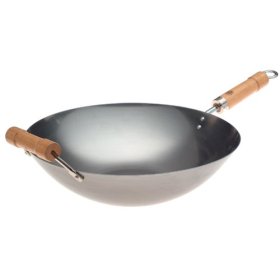 Woks:
Woks:Woks are a versatile round-bottomed cooking pan used in making Asian dishes. They really aren't required for someone who doesn't make a lot of stir-fry. If you come across one, go ahead, but you won't use it a lot. Non-coated is best for these as you use oil that gets incredibly hot and can trigger the toxic fumes of non-stick.
 Double Boilers:
A double boiler is a heavy pot that boils water with a smaller pot that sets inside it. The smaller pot is then heated by the boiling water which makes things cook slower and smoother. I have found 3 applications for double boilers, and I don't even own one anymore. Application 1: Melting chocolate, Application 2: Tempering eggs for custard, Application 3: Cooking alfredo sauce.
As specific as these are, double boilers aren't really necessary. If you can get a stainless steel mixing bowls that will fit into one of your pans, you can make a double boiler of your own. All you have to do is put about 3 inches of water into a pan, bring it to a boil then put your bowl above the water and use it for the purpose you need. When I get to a recipe that uses this, we'll discuss it further.
What pan can you not live without? Questions? Comments? Tweet to @cookingcheap

No comments:
Post a Comment