Right after you get yourself a good knife, you need to worry about maintaining it. The problem with knives, regardless of their quality, is that a knife will begin to go dull as soon as you start using it. The lower the quality, the faster it will go dull. There's an old saying that the most dangerous knife is a dull one, and it's true. A dull knife requires more pressure to go through the food and that excess pressure eventually leads to you slipping with the knife and cutting yourself.
So, the next two weeks in equipment are dedicated to making sure that you have the proper tools to keep your knives sharp and safe. The first of these tools is a good cutting board. Cutting boards protect that razor-thin line of steel that makes your knife sharp from the hard surface that most likely makes up your cabinet tops. That said, I have cut on a cabinet before, but I also had access to an amazing sharpening tool.
Cutting boards are made of a couple types of materials, all of which are softer than stone and metal. This is so your knife can press into the material instead of the material pressing into it. The less give a cutting board has, the more damage it does to your knife's edge. That being said, you don't want something so soft that your knife goes right through it. I've never seen a cutting board that did that, but I'm sure someone, somewhere has a horror story about it.
Your two main materials for cutting boards are going to be wood and plastic. I've seen glass plates shaped like cutting boards, but I'm almost certain they're supposed to be decorative. When glass is pressed to hard it breaks. When it's pressed just hard enough to mar its surface, it creates glass dust which is kind of like sand. That sand will wear your blade down really fast.
Wood:
 Wood cutting boards are the proverbial favorites of chefs everywhere. They're beautiful, they're natural, they're long lasting, and they're way better for knives. However, they're also porous, hard to clean, and expensive. The website where I found that picture to the left right there sells that board for over $60. I'll admit that wood cutting boards can stay in the family for generations. In fact, I'd put money that there's a family somewhere using the same cutting board their Great Great Great Great Grandma used to cut vegetables in the covered wagon. If taken care of properly, a wood cutting board can last forever.
Proper care is the key, though, because if improperly cared for, your board doesn't just become useless, it becomes dangerous. I'm seriously in amazement that my image searches for poorly taken care of cutting boards doesn't come up with anything like I've seen, but trust me, wood cutting boards can be scary. When wood gets really wet and is allowed to dry naturally, it cracks. When wood cracks, it opens up hollows in the wood and releases splinters that can get in your food. Hollows in the wood of a cutting board mean that you might not get all the raw chicken out of the board the next time you clean it. Honestly, I've studied microbiology long enough that the thought of the pores in wood absorbing salmonella today and depositing it on lettuce tomorrow is enough to scare me away from wood boards.
However, if you're willing to spend the money on it and aren't nearly as educated about microbes as I (really, don't try, it's horrible), a wood board will meet your needs, if you take care of it. When you buy a new board, don't assume its already been seasoned or oiled. I typically don't assume that anyone's done anything to make my life easier, and I'm safer because of it. Go down to the drug store and buy some mineral oil. DO NOT USE VEGETABLE, OLIVE, OR ANY OTHER FOOD OIL. We use mineral oil because it has no proteins which can sour, or go rancid. Oiling a board with an oil that will later go rancid is as good as throwing it away
Warm your oil slightly in the microwave for 10 to 15 second and then, with a soft rag or towel rub the oil into the wood slowly and with the grain of the wood.
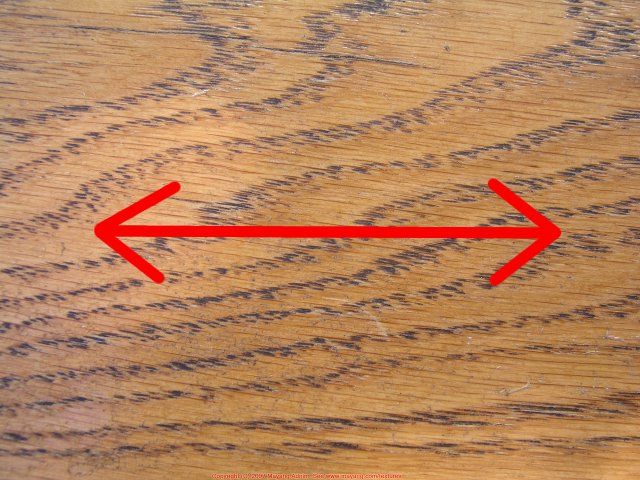 |
| The grain goes this way |
Wait for the oil to soak in and repeat four or five times. This will fill in the pores of the wood and make it more bacterial resistant.
Once that's done, maintaining your wood cutting board isn't as hard as you think. Two main things to remember: never submerge it in water and never ever put it in the dishwasher. When you need to wash your cutting board, scrub it gently with soap and water, rinse it, and pat it dry. That will prevent cracking. If you've cut something like chicken or raw meat (most people suggest you just don't do that), wipe it down with some white vinegar to kill excess bacteria. Some people recommend using bleach on your wood board, but I don't. See, just like bacteria, bleach can soak into the pores of a board and possibly contaminate something later. I just like to prevent poison in my kitchen. Vinegar will also remove bad smells that might have stayed on your cutting board.
As often as once a week and as rarely as every six months, you'll have to reseason your cutting board as mentioned above. This keeps the bad stuff out of the pores and lessens your family's chance of getting sick. If your board ever cracks, there are dozens of resources on the internet about how to reseal it.
As with all your other items, this can be purchased used, but you want to be very, very, very careful when buying a wooden cutting board. As I said, you can keep these things forever, if they're properly maintained, but if they aren't you could end up getting sick or hurt. Check a cutting board for deep cracks that go all the way through it. Even though I mentioned resealing resources a second ago, you don't know how long that crack's been in that board or how much the family has worked to keep it clean. There's a chance that you're buying a board with a crack that's been building up bacteria for 5 years. Ask the seller when the last time it was seasoned then do it again when you get home.
Plastic:
Plastic cutting boards are my favorite thing in the world, for many reasons. First off, though they may not be as pretty as a wooden cutting board, they're inexpensive. That ad up there (click it, just for fun!) has plastic cutting boards for $16 a piece. That might seem like a lot, but it's at Sur La Table, a really expensive store, and they do that folding thing. Just think, for the price you paid for the wooden board I put up there, you could buy 3 of these with the tax. On the other hand, you could go to Wal-Mart and buy a 3-pack of different sized cutting boards for $13. They don't fold or anything like that, but they work.
Here are the pros of plastic boards: they're non-porous, they clean easily, they're cheap as heck, and I have yet to have to throw one away. There are even really thin cutting mats that look like cheap place mats that we have in our cabinets 4 years later. It's really hard to destroy these things.
The other thing I like about plastic cutting boards is that you can get them in more than one color. You may wonder why that's important, but it really is when you have more than one. See, when I make food, I'm often cutting meat and vegetables at the same time instead of cutting one, washing the cutting board, then cutting the other. The other day, I had my daughter tenderizing chicken while I cut vegetables. When you have those kinds of things going on in the same kitchen (I always recommend training your kids to help), you absolutely need more than one cutting board. When you have more than one cutting board, it's easier to keep track of them if you have more than one color.
See, you probably realize that you can't cut your salad vegetables on the same cutting board that you cut your chicken before you cooked it without washing them in between. What you may not realize is that the grooves that the knife leaves in your cutting board may not have been cleaned out by that quick scrub with soap and water that you gave the board between prep. To eliminate this problem, we have multiple cutting boards. I found this set of colored cutting boards at Ross for $20. It has 3 colored cutting boards, red, blue, and green, and a holder for them. This thing retails at $65. I call it a win.
When I cut my vegetables, I know that I used the red one (I'm supposed to use green, but that's the one I picked), so I know I can't cut my chicken on the red one, I have to use the green or blue. In OSHA approved kitchen, there's actually a full color-coded method to this, but my rule is to just not use the same color for two different types of food. You can pick up colored cutting boards just about anywhere nowadays.
The best thing about plastic is its ability to be washed. When I'm done with my cutting for dinner, I stick them in the dishwasher. The high temperatures of the dishwasher make it so no bacteria can survive. If you don't have a dishwasher, you can always put hot water in your sink and add a tiny bit of bleach to it for your cutting boards to soak in. Always make sure to rinse them off afterward.
No matter what cutting board you choose, you have to be comfortable with it. Make sure, if you find a cutting board at an estate sale that's got 1" long legs, that you'll be comfortable cutting on top of it. Heaven forbid you spend money on something you'll hate.

